| Item | Pull-down | Pull-out |
|---|---|---|
| Hand motion | downward, into the bowl | outward, toward you |
| Hose | ~150 cm total, ~60 cm usable | ~130 cm total |
| Hose build | nylon braid over EPDM inner | nylon braid over EPDM inner |
| Retraction | gravity counterweight ball; magnetic docking on flexible-neck models | gravity counterweight ball |
| Spray head | ABS standard, 50–100 g; metal optional | ABS standard; metal optional |
| First thing to wear | the retraction path | hose friction over horizontal travel |
| Pin on the spec | hose length, retraction type, head material | hose length, head material |
The fork is the hand motion
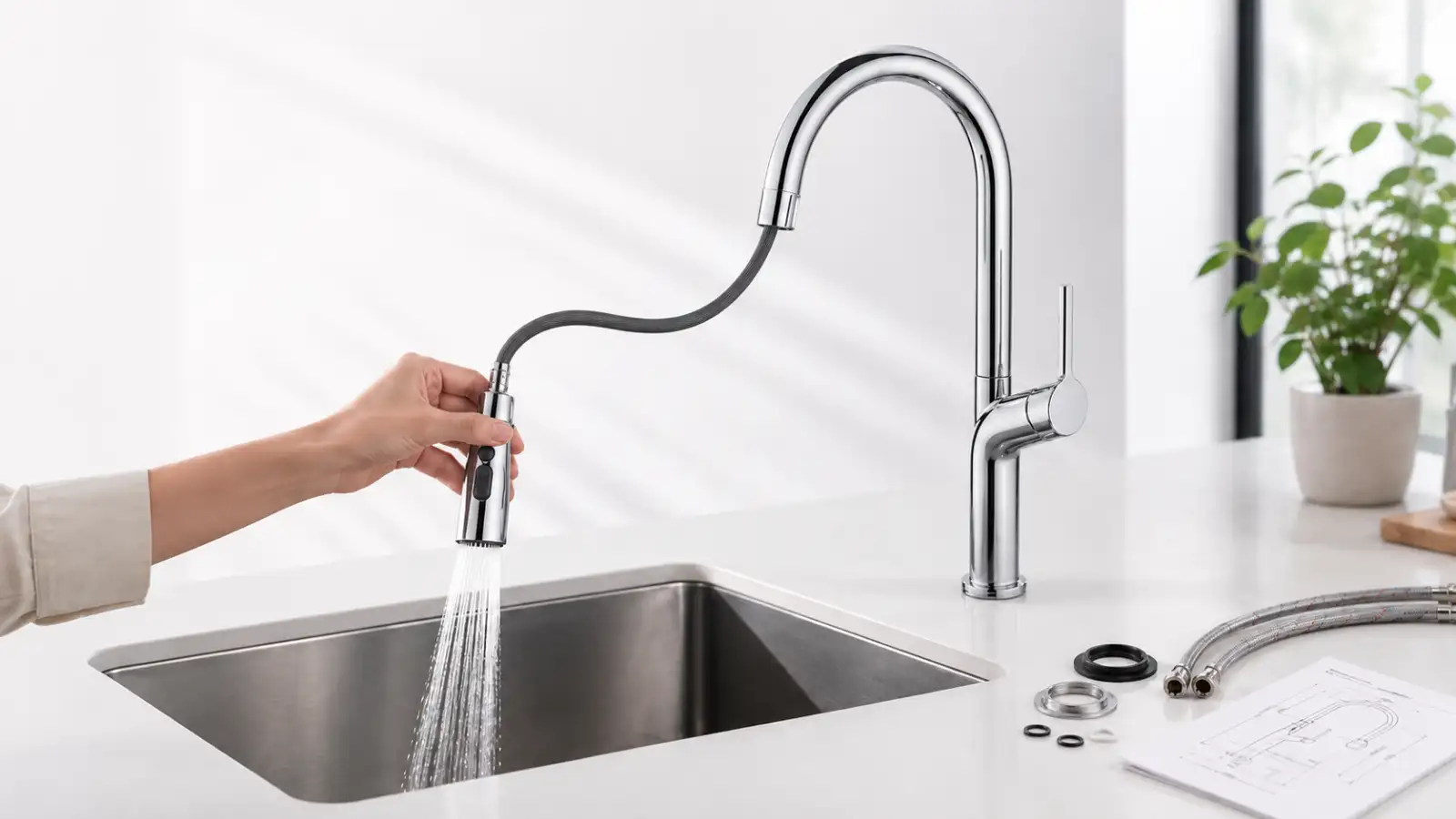
Pull-down means reaching down into the bowl. Pull-out means pulling the head out toward you, across the counter — the motion behind any kitchen faucet with a pull-out sprayer. The talk about deep sinks and tall pots follows from that choice.
A deep single bowl suits the downward reach. A shallow bowl under a low cabinet suits the short outward one. Sink size matters because it changes which motion is comfortable, and for nothing else.
The market sells pull-down as the upgrade and pull-out as the older option. A well-built pull-out outlasts a cheap pull-down, and in a low cabinet the pull-out is simply the right one to specify. One more myth rides along with the upgrade story: that a pull-down pushes water harder. It doesn’t — both run the same line pressure, and the taller arc only looks more forceful. Pick the type by the task done most at that sink and the room under it.
What the motion becomes under the sink
Reach down and the hose has to climb back up and seat into the spout, dragged by a counterweight. Reach out and it runs a shorter, flatter path with a lighter head. Same parts, two routes. Which one a faucet runs comes down to the motion, decided above the counter.
We use the gravity counterweight ball on the bulk of our kitchen lines, behind a stainless, brass, or zinc neck alike. The ball pulls the same way regardless, so it carries from one build to the next without a redesign. Magnetic docking we keep for the flexible-neck models, where there is no rigid arm for the head to seat against.
The hose is nylon braid over an EPDM inner tube, picked for the water-contact and environmental requirements.
Most pull-down and pull-out faucets mount in one hole, so the deck cutout and plate matter as much as the hose — covered in our single-hole kitchen faucet install and sizing guide.
Where each one wears first
A pull-down that won’t retract has a short list of causes, and the magnet is at the bottom of it. The weight has slipped on the hose, the loop has snagged on a disposal or a shut-off valve, or the head has been knocking against the spout seat for a year. Pull-outs go a quieter way — the hose wears where it drags over the cabinet edge, use after use.
On our side, every new hose batch runs a 100,000-cycle bend-and-retract test before it clears. Each unit off the line then gets 500 cycles, since the material behind it is already proven. A buyer can ask which figure covers the batch and which covers the unit — a cycle count with no scope behind it says little.
How long the hose then survives a packed cabinet, the production side can’t say.
Spray head: ABS or metal
The spray head shell comes in ABS as standard. It weighs 50 to 100 grams depending on the model and takes the same finish as the body. ABS keeps the head light, which is the whole reason it is standard. Metal we can do, but it is heavier, and a heavier head drops harder onto the spout seat.
A plastic head reads as the cheap part. Engineering ABS on the piece you grab and drop all day is a weight call, and even brand-name replacement heads come in ABS. A buyer should catch one thing: plating on a part handled wet all day, with nothing on the spec saying what is under it.
One client pushed the other way. A North American multi-unit residential project, in talks with us since last December, wanted the whole faucet in 304 stainless — head included. They had seen plastic heads discolor and didn’t want that in their units. They also asked for a brushed finish, on the view that brushed holds raw-metal color the most steadily. Their spec ran to 344.5 mm overall on a 129.8 mm body. Our standard body is 120 mm and runs closer to 400 mm overall, so every part came off the standard line and got rebuilt to their numbers. The 304 head is heavier and costs more. They took that trade to keep plastic out of the picture.
Spray modes come as two- or three-function heads, both made to order. The head stays in whatever mode you set until you switch it back, with no snapping to stream on its own.
What to pin, and what we are
We build these faucets and read the specs that importers and distributors send over. We don’t sell into DIY retail, we don’t see the kitchens these end up in, and we don’t rule on a market’s plumbing code. The production side is where we can hand a buyer numbers — hose length, retraction type, head material, and the test behind each.
Threads go out to suit the market, NPT or G/BSP. Hoses join by quick-connect or by thread, and across our own lines the spare hoses and heads interchange. Kitchen models ship single-hole by default, with arc height and swivel angle built to order.
Our kitchen faucet and basin faucet pages carry the builds, and the shower set range runs on the same hose and head logic. Whoever is reviewing a spec can reach the team on the contact page.
FAQ
Is a pull-down or pull-out kitchen faucet better for a small sink?
A pull-out. The short reach and lower spout fit a shallow bowl and a low cabinet, where a tall pull-down arc has no room.
Does a pull-down faucet need a deep sink?
It rewards one. Over a shallow bowl, the high arc throws water at the backsplash.
Why won’t my pull-down faucet retract?
Check under the sink before the head. The counterweight has slipped on the hose, the hose loop is caught on something in the cabinet, or a quick-connect has shifted. The magnet is the last thing to suspect.
Are pull-out faucet hoses universal?
Across our own lines, yes — the spare hoses and heads interchange, by quick-connect or thread. Between brands, treat them as model-specific until the connector is confirmed.
Is a metal spray head better than a plastic one?
No, not on its own. ABS keeps a part you lift all day light, and metal is the heavier option. What counts is the spec naming the material, whichever one ships.
Sources
- Lowe’s — Pull-Down vs Pull-Out Kitchen Faucets buying guide Referenced for both types delivering the same water pressure.
- Build with Rise — Pull-Down vs Pull-Out Referenced for ergonomics, clearance, hose reach and docking reliability.
- Bathify — Pull-Down vs Pull-Out Referenced for basin-depth and clearance guidance, with pull-out specified for low-clearance layouts rather than treated as the inferior option.
- Background, not a standard — faucet retraction-mechanism reference Referenced for counterweight positioning, under-sink hose path and wear.