| Item | Single-hole | Three-/four-hole |
|---|---|---|
| First install | pro or DIY | pro fitter |
| Reinstall or swap | one nut, doable solo | three-plus nuts under the cabinet |
| Style change later | drop-in often | re-cut or re-plate |
| Project serviceability | high | low |
| Share of our kitchen shipments | — | small |
The numbers to lock before the order
A single-hole faucet still has to fit, and “one hole” hides the measurements that decide whether it does. Get them on the spec before tooling, not after the countertop is cut.
| Measurement | Typical | What goes wrong if skipped |
|---|---|---|
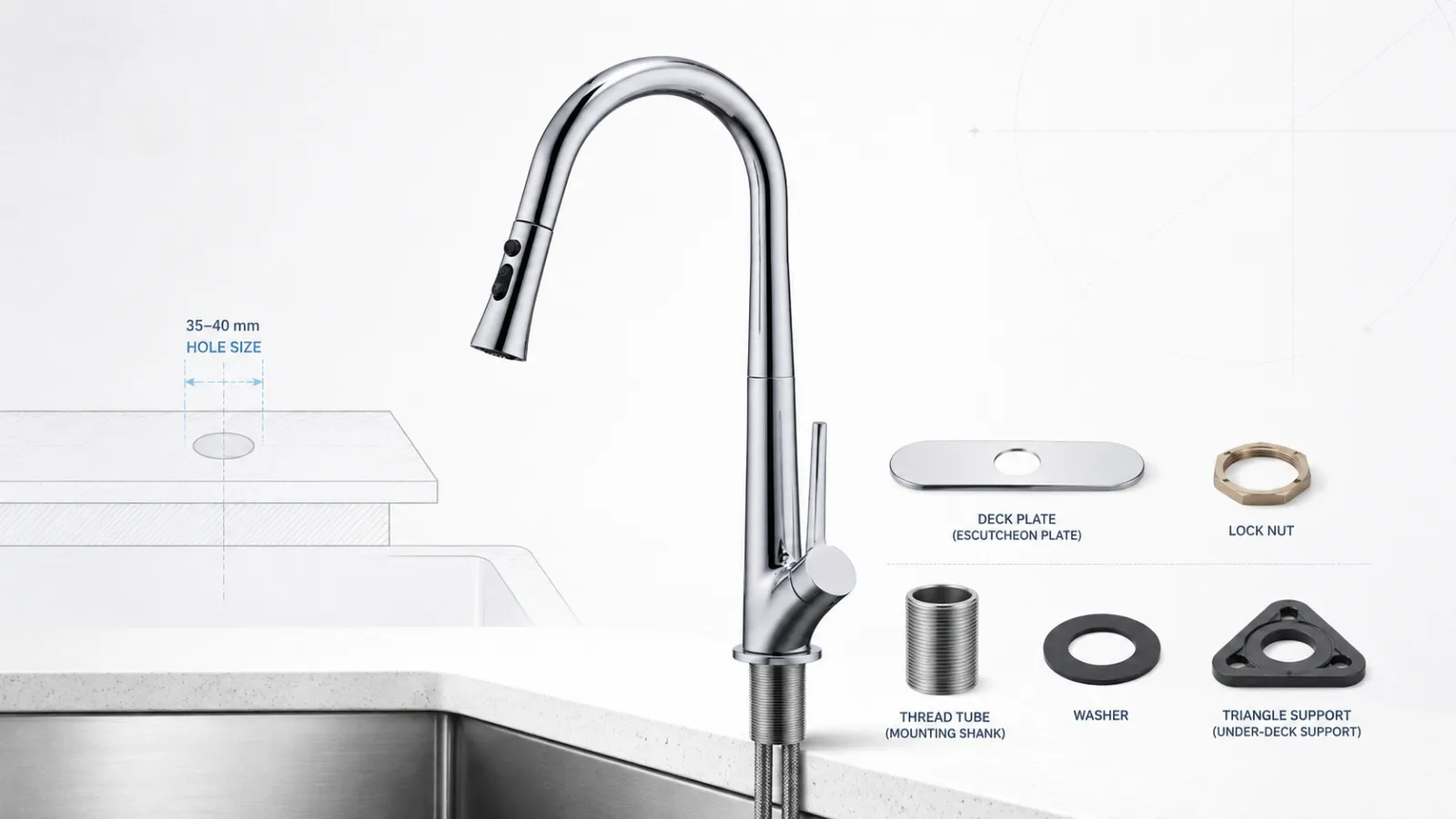
| Mounting hole diameter | 35–40 mm (≈ 1⅜–1½ in) | hole too big, faucet won’t seat, plate won’t cover |
| Max deck thickness | per model (shank length) | thick countertop, lock nut can’t reach the threads |
| Hole spacing (reused holes) | 3-hole outer ≈ 203 mm (8 in) | deck plate too short to cover |
| Sink gauge and support | — | thin sink flexes, faucet feels loose |
The hole diameter runs 35 to 40 mm on our single-hole bodies (about 1⅜ to 1½ inches). “Standard” is the trap word here, because the figure that matters is the one on the model’s spec sheet, not the one a forum calls normal.
In 2022 a Gulf-region project buyer ordered a large run of kitchen faucets, single- and three-hole mixed, for a build with no retail side. We were careful, the way we are with any project: we confirmed the material, the cutout size, and the countertop’s material and thickness. Samples went out, the buyer approved them, and we reconfirmed every detail before production. Delivery went clean. Early the next year the call came with photos — the countertop had been cut to a different measurement standard, and every opening ran about 20 mm too wide. The faucets wouldn’t seat, and the deck plates couldn’t cover the gap. The cause was the cutout standard on site. We had no stock part that would close a 20 mm overshoot. We cut a one-off mold to fix that batch; at under two thousand pieces, used once, it didn’t earn tungsten tooling.
Which measurement standard a countertop shop cuts to, I can’t see from the factory — that gets set on site, after our spec leaves.
Deck thickness is the second number. The shank and lock nut only reach so far, so a thick stone countertop can leave the nut short of the threads. We give a buyer the max deck thickness per model, and the thread tube comes in 60, 70, and 80 mm to suit it.
Our default is the 60 mm thread tube, and it suits a deck of roughly 20 to 30 mm. That is the number to argue with before the order, not after. A published spec sheet from a major North American brand lists a max deck thickness of 2-1/2 inches — 63.5 mm — on a single-hole pulldown. A buyer who reads that figure, then orders our default, is ordering for a deck less than half as thick. Stone tops, laminated edges and farmhouse ledges routinely run past 30 mm. When a project’s deck is thicker, the fix is the 70, 80 or 100 mm tube, and it has to be named on the order.
The plate eats into that budget too. Ours is 6.35 mm thick, and it sits between the deck and the faucet body, so the thread has that much less to reach through. Deck thickness on a spec sheet means the deck plus the sink ledge plus the plate — not the countertop alone.
A deck plate covers holes; it doesn’t fix spacing
Spacing only matters when a buyer reuses old holes. A three-hole sink runs about 203 mm (8 inches) across the outer pair. Our deck plate ships about 1 cm wider than the body, to cover the opening around it.
The plate’s reach is arithmetic, not a claim. Ours runs 10.25 × 2.5 inches (259 × 64 mm) with a 35 mm centre hole, so from the faucet centre to the plate edge is 5.125 inches. Subtract the radius of the hole the plate has to swallow and the outer hole can sit about 4.4 inches from centre before the plate stops reaching it. That covers a 4-inch centerset and it covers the 8-inch three-hole spread at 203 mm, with a little to spare. It does not cover a 12- or 16-inch widespread. A published spec sheet from a major North American brand lists the same escutcheon footprint — 10-1/4 by 2-1/2 inches — which is why “universal” reads as a size class rather than a promise. Past roughly 8.8 inches across the outer pair, no plate of that footprint reaches, whoever made it.
Retail listings sell these as universal and then carry a line in the details telling buyers their holes may sit too far apart. Both statements are on the same page. The number is what settles it.
Why a single-hole faucet feels loose
The last number is the sink itself. A heavy single-hole faucet on a thin stainless sink works like a lever. Pull the head down, the deck flexes, and the faucet reads as loose.
The fix sits under the deck. We fit a lock nut, a screw fixing, and a triangle support as standard, with a 201 stainless lock nut by default. A thin-gauge sink can take extra bracing, and a buyer flags that before we ship.
A thin sink is one cause of a loose faucet. A short thread tube is the other, and it is the one a buyer chooses.
In 2023 a contractor in the UAE bought a run of kitchen faucets for a build. Price was the whole conversation — compliant and functional was the brief, nothing beyond it. He asked us to fit a shorter thread tube than the deck called for and a plastic lock nut, and it saved about fifty cents a unit. We built what he specified. On site the nut barely caught the threads. The faucets went in, and they moved when anyone pulled the head down. The complaints came back to him, and he came back to us. We cut a new run of 70 mm thread tubes and shipped them out, and his crew went back through the units.
Fifty cents a unit against a second visit to every sink in the building. The thread tube is not where a project saves money.
Reach and footprint, past the hole
The hole is one fit; the spout is another. Too little reach and the head lands behind the drain, not over it. Arc height sets the clearance under the spout, and the splash out of a shallow bowl. A wide base hides the old cutout; a narrow one can leave it proud.
The same body does not always cross to a laundry or bar sink. A kitchen single-hole built for a deep bowl can over-reach a small bar sink, or sit too tall over a shallow laundry basin. The shank length has to match the thinner deck too. A buyer moving a kitchen faucet onto another sink checks reach, height, and shank before the deck is drilled.
The same faucet, by market
The same body changes name and fitting by market. North America says faucet, deck plate, NPT; the UK, Europe, and Australia say mixer tap, and the connection runs G/BSP. We quote the hole in millimetres first, with the inch in brackets for North America.
The unit itself is the quiet risk. A faucet cut to 35 mm and one cut to 1⅜ inches are close but not identical. A countertop shop reading the wrong unit is how a cutout drifts. The Gulf overshoot started there — one side cut to a standard the spec hadn’t pinned. We write the hole in both units now, and we ask which one the countertop will be cut to.
What to pin, and what we are
We are a faucet manufacturer that reads the specs importers and project buyers send over. We build to them, we don’t sell DIY retail, and we don’t cut countertops or set a site’s measurement standard. What we put numbers on is the faucet: hole diameter, deck thickness, thread tube, and the hardware under the deck.
Our kitchen faucet range is single-hole first, with three- and four-hole on request. The under-deck hose and retraction work the same as on any pull-down kitchen faucet. A buyer mapping a project to a cutout can reach the team on the contact page.
FAQ
What size hole does a single hole kitchen faucet need?
35 to 40 mm, about 1⅜ to 1½ inches, on our bodies. Treat that as a starting point and confirm it against the model’s spec sheet, since the figure shifts by model.
Can a single hole kitchen faucet fit a three-hole sink?
Yes, with a deck plate over the outer holes. It works when the plate is wide enough for the spacing; a non-standard or extra-wide spread can leave the old holes showing.
Do I need a deck plate for a single hole faucet?
Only to cover holes you are not using. On a fresh single hole it is optional; on a three-hole conversion it is what hides the other two.
Why does my single hole kitchen faucet feel loose?
Look at the sink before the faucet. A thin stainless sink flexes when a heavy faucet levers on it, which reads as a loose faucet. Under-deck bracing — a lock nut, a screw fixing, a triangle support — is what steadies it.
What can I do with extra sink holes after fitting a single hole faucet?
Cover them with a deck plate or a hole cover, or fill them with a soap dispenser, a filtered-water tap, or an air switch. Decide before the countertop is cut, not after.
What is the difference between a single hole faucet and a single handle faucet?
Hole count versus handle count. A single-hole faucet mounts in one hole; a single-handle faucet has one lever but can still call for more than one hole. A buyer should spec both.
Can I install a single hole kitchen faucet in a laundry or bar sink?
Sometimes, but check reach and height first. A kitchen spout built for a deep bowl can over-reach a small bar sink or stand too tall over a shallow laundry basin, and the shank has to match the thinner deck.
What is the maximum countertop thickness for a single hole faucet?
It is set by the shank and lock nut, not a fixed number. We list a max deck thickness per model and offer the thread tube in 60, 70, and 80 mm, so a thick stone top still lets the nut reach the threads.
Sources
- Delta Faucet — What size hole does the faucet need? Referenced for the point that the product Technical Specification sheet should be checked for the recommended hole size and spacing required for installation.
- Lowe’s — How to Install a Kitchen Faucet Referenced for sink hole count checks and the use of a deck plate when installing a one-hole faucet in a three- or four-hole sink.
- The Home Depot — How to Install a Kitchen Faucet Referenced for one-hole installation and escutcheon / deck plate use to cover outside holes.
- Moen — How to Choose a Kitchen Faucet Referenced for checking sink hole configuration, escutcheon plate use, and the need to check the specification sheet by faucet model.
- Kohler — Kitchen Sink Faucets Referenced for one-, two-, three-, and four-hole faucet mounting options, deck plate retrofitting, hole spacing, and replacement checks.
- Hunker — Sink Faucet Hole Sizes Referenced for the common 1⅜ inch faucet hole size, some faucets requiring 1½ inches, and checks around countertop depth.
- Forious — Hole Saw Sizes for Kitchen Faucets Referenced for common faucet hole sizing and spacing context used as general background, not as a substitute for a model specification sheet.