| Part | Materials we run | Touches water? | What the spec line should pin |
|---|---|---|---|
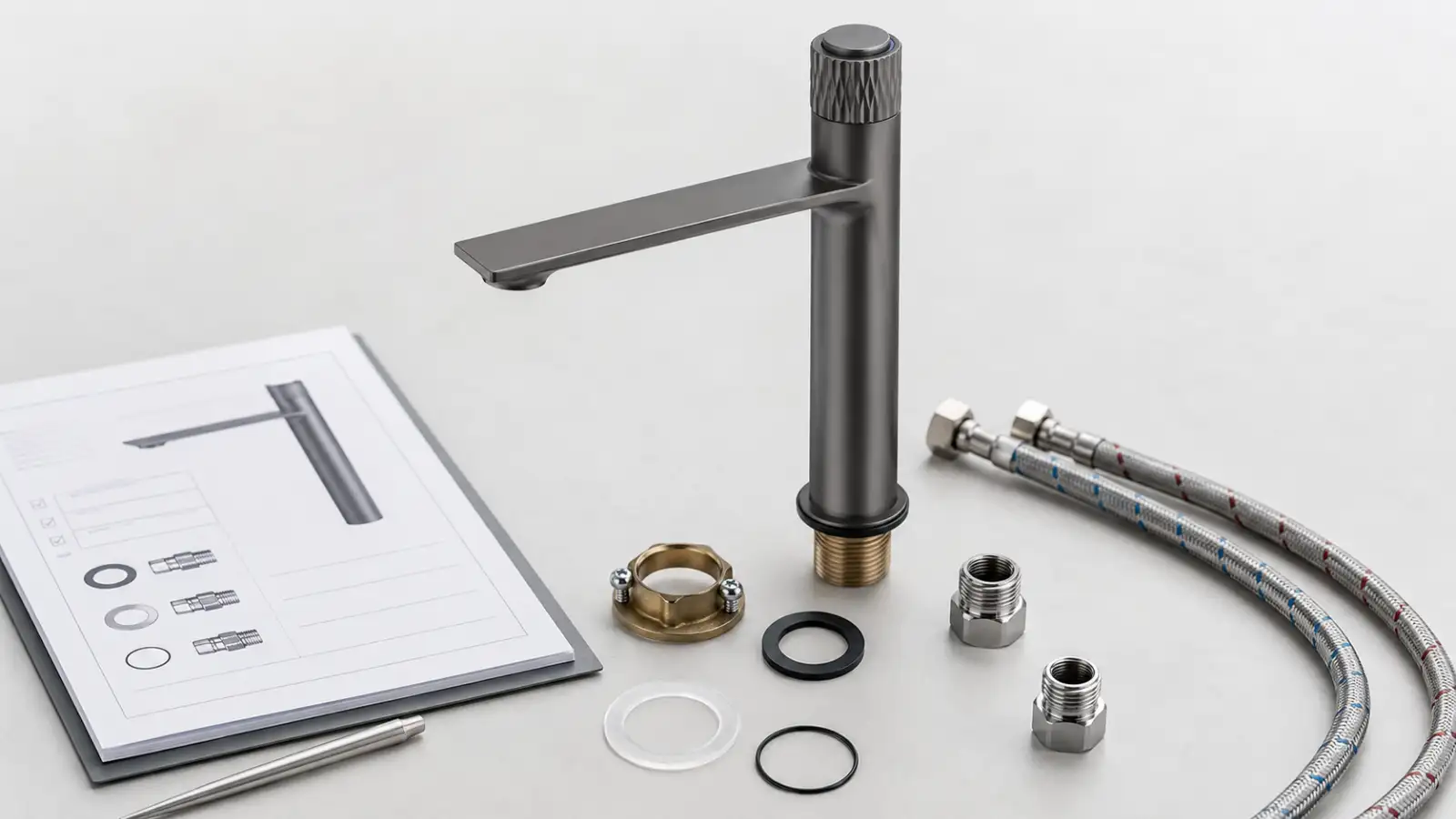
| Body | brass, SS304, SS201, zinc alloy | yes (interior) | the body metal, and whether the interior path is the same metal |
| Waterway (interior path) |
copper / brass or stainless | yes | the wetted-surface metal — the line your market regulates |
| Cartridge | ceramic disc | yes | ceramic; cycle rating if the market asks for it |
| Handle | zinc alloy, sometimes stainless | no | finish only — nothing here affects water safety |
| Mounting nut | stainless, cast iron, brass | no | corrosion behavior under the deck, not in the water |
| Pull-out spray head | nylon fiber | yes (lining) | the lining material where a lead-free rule applies |
What “brass” on a spec line actually covers
“Brass faucet” means the body is brass. The body holds pressure and takes the wear, so the word is reserved for it.
The handle is a separate call. We build brass-faucet handles in zinc, by choice. A copper-alloy handle is heavy, it touches no water, and the extra metal buys weight rather than life.
“All brass body” and “brass construction” read as if the whole unit is brass, which it rarely is. The handle, the decorative shell, sometimes the spray head come in zinc or plastic. For a buyer, that is a labeling habit to read correctly before it reaches the spec sheet.
The part your destination regulates is the one touching water
North America and the European Union take most of our volume right now. Both regulate the metal that meets water; neither regulates the finish or the handle. What each one accepts as proof differs, and that gap is the buyer’s to manage.
In the United States, lead-free is a number: a weighted average of 0.25% lead across the wetted surfaces, set by the Safe Drinking Water Act. NSF/ANSI/CAN 372 covers that lead-content calculation. NSF/ANSI 61 is a separate check — health effects and what leaches from a drinking-water part.
The European Union is moving to one framework and is not there yet. Article 11 of Directive (EU) 2020/2184 and six acts published in April 2024 set minimum hygiene requirements for parts that touch drinking water, taps included, and they apply from 31 December 2026. Until then, member-state rules still vary. A buyer shipping to the EU cannot reuse the US lead-free number as the answer.
So the spec line that clears a container is the waterway material. A PO that confirms the body is brass and never states the interior metal has checked the wrong line. When an importer’s review asks which surface the 0.25% covers, a PO that only says “solid brass, lead-free” has no answer ready.
A buyer should get the certificate name and the exact SKU range it covers. A blanket “lead-free” on a cover sheet does not say which products were tested. On our side, we build the wetted path to the destination’s material rule and name the products that covers.
Stainless: 304, 201, and the one case 316 earns its price
We run 304 and 201. 316 ships when a customer asks for it.
201 trades some nickel for manganese. It costs less and resists corrosion less. A spec that says only “stainless” hides which of the two arrived, and the two are priced and built apart. Name the grade on the line.
316 adds molybdenum, which gives it lower pitting risk than 304 or 201 in chloride-heavy conditions. For an inland kitchen line, paying for 316 buys a property the installation does not call on. Order 316 when the destination is coastal or high-chloride. Anywhere inland, the grade is a smaller factor than wall thickness and casting.
Verifying material without standing on the production floor
We are a faucet manufacturer that reviews the specs importers and distributors send over. We don’t sell DIY retail, we don’t visit job sites, and we don’t decide a destination’s plumbing code for anyone. What we can speak to is the production side: what goes into each part, and how it gets checked before it leaves.
Two of those checks belong on a buyer’s spec sheet, and both already run on our line.
Every new batch of incoming metal arrives with a supplier material report, and we pull samples for a spectrometer reading. A buyer can ask for that report on the wetted part. Putting it on the spec line is on the buyer, not the supplier.
Every faucet surface goes through salt spray before a finish is signed off. We run acid salt spray and neutral salt spray — 24 hours acid as our floor, 48 when the spec is strict, 72 hours neutral. A buyer should ask which part the hours cover and which test, because a number with no part attached means little.
Those hours are our own floor, not a number I can hold up as an industry standard.
Air and water tightness gets tested on every unit before it ships, not on a sample. Worth asking a new supplier whether their tightness check is 100% or a pull.
The folk tests fall short here. A magnet barely moves on 304 and moves more on 201, so it misreads the grade instead of confirming steel. Weight tells you density, not which alloy sits where. Neither one replaces a material report.
Threads switch by market — NPT or G/BSP, supplied to the destination. Pin the thread standard to the country, not the catalog default.
Our basin mixer, kitchen faucet and shower set pages list configurations by build. The team that reviews these specs is on the contact page.
FAQ
Are solid brass faucets better than stainless steel faucets?
As a body material, neither wins outright — both last when the casting and wall thickness are right. The choice that changes a buyer’s risk is which part holds each metal, and whether the wetted path meets the destination rule.
Do zinc alloy faucets last as long as brass?
On a handle or a trim shell, lifespan is the wrong test. Those parts carry no pressure and touch no water, so zinc there is a normal build choice. On the body or the interior waterway, zinc is the placement to pin down on the spec before it ships.
How can I tell if a faucet is solid brass, stainless steel, or zinc alloy?
Not by a magnet, and not by weight alone. A magnet barely reacts to 304 and reacts more to 201, and chromed zinc passes a quick heft test. For a confident answer, ask for the material report on the wetted part. For a new supplier, add a spectrometer reading on a sample.
Does “lead-free” mean zero lead?
No. In North America it means a weighted average of 0.25% lead across the surfaces that touch water, set by the Safe Drinking Water Act.
Is stainless steel better for a coastal bathroom?
For salt air and chloride, 316 carries lower pitting risk than 304 or 201. Order it when the project is coastal. Inland, other parts decide the lifespan before the steel grade does.
Sources
- U.S. Environmental Protection Agency — Use of Lead Free Pipes, Fittings, Fixtures, Solder, and Flux for Drinking Water Safe Drinking Water Act, Section 1417: lead-free defined as a weighted average of 0.25% lead across wetted surfaces.
- NSF — Safe Drinking Water Act Requirements NSF/ANSI/CAN 372 for lead content and NSF/ANSI 61 for drinking-water-contact product health effects and leaching.
- European Commission — Drinking water Directive (EU) 2020/2184, Article 11; the six material-contact acts published 23 April 2024, applying from 31 December 2026.
- Background reading, not a standards source — Starcraft Custom Builders, Faucet Basics: How Are Faucets Made? Referenced for faucet construction background, 304 vs 316 and dezincification context.