
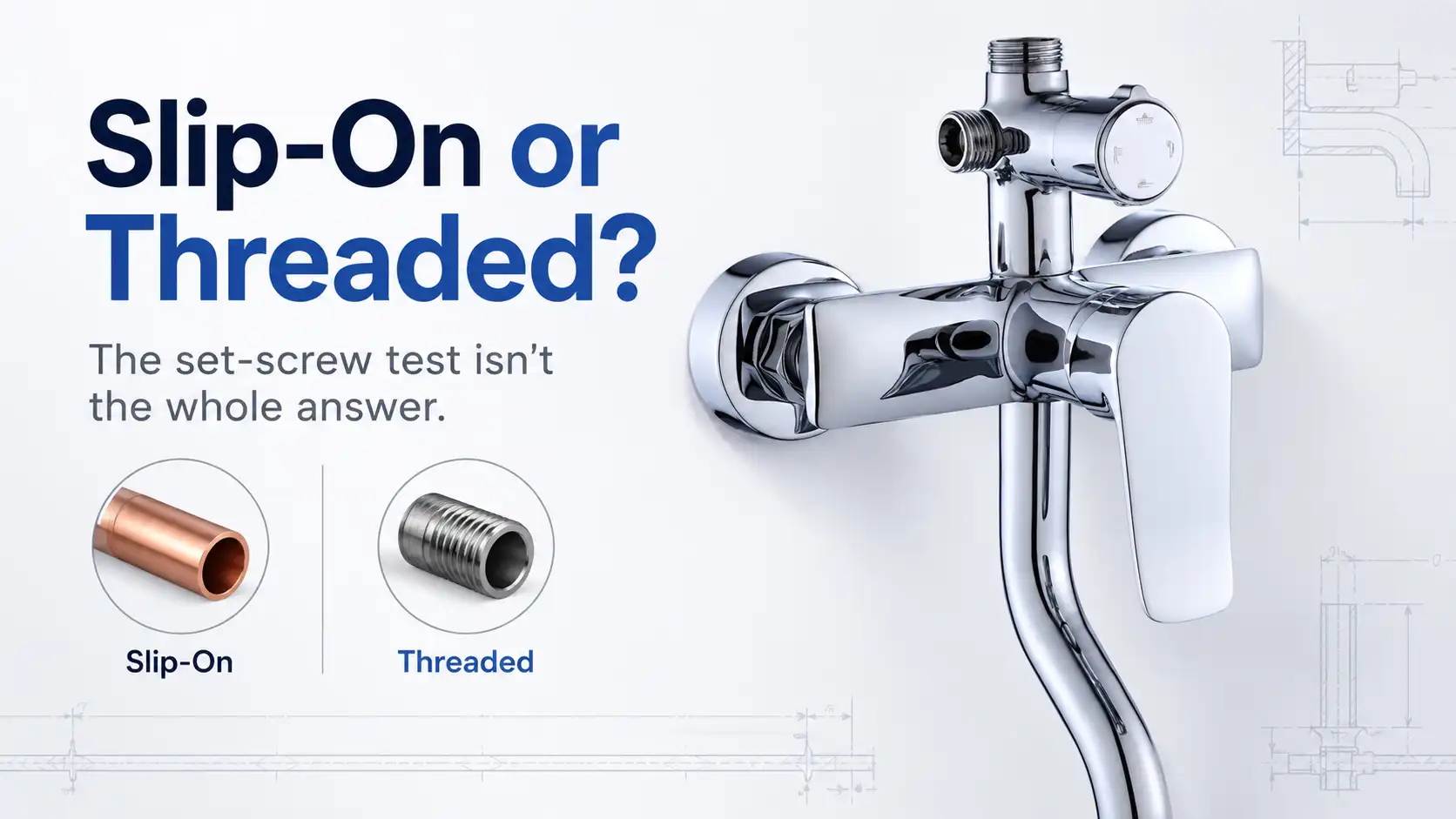
One naming note before the detail. Slip-on tub spout and slip-fit tub spout mean the same connection, and listings use both. This guide says slip-fit for the assembly and slip-on where the trade does.
On a dual-installation model the screw shows that a slip-fit assembly is sitting in there. It doesn’t confirm how that spout is going onto the pipe.
| Slip-fit | Threaded | |
|---|---|---|
| Meets | a smooth copper tube | a male-threaded nipple |
| Held by | an internal clamp, locked by a set screw | the thread itself |
| Pipe past the finished wall, our spouts | about 40 mm | about 15 mm |
| Sealed by | O-rings and washers inside the spout | thread sealant on the nipple |
| Switchable on site, our spouts | no | no |
Where the rule stops holding
On a single-connection spout the test works. A slip-fit body carries an internal assembly that slides over smooth copper, and a set screw clamps it. A threaded body carries internal threads and no screw. Look into the opening and the nipple is visible.
The test fails on spouts built to do both. Those exist. The set screw is present either way. The same catalog photo covers two different installations, and reading the underside teaches you nothing about which is in front of you.
We don’t build that way. Our slip-fit and threaded spouts are separate SKUs. A slip-fit body has no internal thread to fall back on. A threaded body has no clamp to remove.
That cuts both ways, so it’s worth saying plainly. On our line the set screw is unambiguous. If it’s there, the spout is slip-fit. What it costs is the escape hatch. A buyer who receives threaded spouts for a building plumbed with smooth copper cannot loosen a screw and adapt. The parts go back.
Which moves the decision earlier. With a dual-installation spout, the connection gets settled by whoever is standing in the bathroom. With ours it gets settled on the order, before anything ships. Someone has to look at the wall first.
That someone is rarely the factory. A buyer ordering for one renovation knows the building. A buyer ordering stock for a market knows what that market plumbs with. Both of those questions get answered before production, and neither can be answered from here.
For a distributor the same fact lands as an inventory question. Two connection types means two lines on the stock list rather than one line that flexes. The separation removes one source of installation mismatch, since a spout that arrives can only go on the pipe it was built for. It also asks the distributor to stock two connection SKUs instead of one.
What’s actually inside a slip-fit spout
The mental picture most people carry is a screw biting straight into copper. It explains a worry that turns up repeatedly on plumbing forums — that tightening the screw scores or crushes the tube.
The inside is more built up than that. Our slip-fit spouts carry a clamp, two washers and two O-rings, seated in grooves inside the body. The clamp grips. The O-rings seal, in NBR, and the washers hold the stack in position and spread the load as the clamp closes.
The set screw bears on the clamp. Copper never sees the tip. Turning it squeezes the clamp around the tube instead of driving a point load into the pipe wall. That matters for more than the pipe’s appearance. A dented tube is a poor sealing surface, and the O-ring sitting right behind the clamp has to seal against it.
Set screws go out in stainless, brass or plated carbon steel, hex drive, by SKU and by the finish they have to disappear into. It’s a small part to specify and an awkward one to ignore. The screw sits in a wet opening on the underside of the spout. It’s also the one component a service technician has to turn years later. A seized screw turns a ten-minute O-ring swap into a spout replacement.
The assembly comes out. It’s the servicing path, and it’s the same motion the dual-installation spouts use to convert. On ours the bore behind it has no thread. So pulling the assembly is what a technician does to replace a worn O-ring, and it isn’t a way to change the connection.
Threaded spouts run 1/2″ NPT as standard, cut to other specifications on request. Plenty of North American listings call this connection 1/2-inch IPS. That term started as a pipe sizing system rather than a thread form, and it now gets used loosely. Some suppliers mean the tapered NPT thread by it. Others mean a straight thread that seals on a washer. Where a listing says IPS, confirm the thread form rather than assuming it. Thread position varies by body. Some sit at the back, close to the wall. Others sit further forward, which means the nipple has to reach deeper into the spout before it engages. Two spouts with the same overall length can want different nipples for that reason alone. The tub faucet parts guide covers where the spout sits in the rest of the set.
The two connections want different pipe lengths
Here’s where tub spout replacement by matching the old one comes apart. The old spout and the new one can match in length, finish and outlet, and still not fit. The number that decides it sits behind the wall.
Our slip-fit spouts are built around a copper tube standing about 40 mm past the finished wall. Our threaded spouts are built around a nipple standing about 15 mm past it. Neither figure is a faucet standard. Both get set during the rough-in, by whoever ran the pipe, long before anyone picks a spout.
Published installation instructions for some slip-fit bath spouts fall near our 40 mm figure. The threaded case varies more, because thread position inside the body varies.
Two things follow from the gap between those numbers. A slip-fit spout on a wall plumbed for threaded sits well off the wall, since it expects a tube more than twice as long. And a spout ordered without anyone checking the wall arrives correct on every visible dimension. It’s wrong on the one that’s hidden.
We don’t publish those figures on a cutsheet. They aren’t a faucet specification the way a thread size or a flow rate is. They belong to the plumbing rough-in, and they’re worth asking about at quotation rather than at delivery.
On a sample, they’re checkable in about a minute. Slide a length of the tube the building actually uses into the spout and see where it stops. For a threaded sample, run a nipple in and count how far it goes before it seats. Either test answers the question the photo can’t.
The gap behind the spout isn’t one problem
A new spout that won’t sit flush gets filed as one complaint. At least four separate things produce it.
The pipe is too long. The connection type doesn’t match what the wall was plumbed for. The pipe isn’t square to the wall, so the spout touches on one side and stands off on the other. Or the wall isn’t flat, and a tile bed or thick backer pushes the spout off by a few millimetres across its footprint.
Cutting the pipe fixes the first. It fixes the second only by accident. It does nothing at all for the third or the fourth. Caulk seals a perimeter that already closes properly. It cannot correct the wrong connection, a stub-out cut long, or a pipe running at an angle. Used to fill a real gap, the bead shrinks, and a year on the same gap is back looking worse.
The tell is whether the gap is even. An even gap all the way round points at length. An uneven one points at angle, or at the wall.
Our spouts take up about 0.5 mm of unevenness in the wall surface. A seal goes in the box for the joint at the wall. Half a millimetre covers a slightly proud tile. It won’t cover a pipe cut long or a stub-out running at an angle. The spout itself cannot square an angled stub-out.
Backs come flat or with a flange, by SKU. A flange puts a wider footprint against the wall, which changes how much an uneven surface shows underneath. A flat back sits tight to a smooth surface and reports every deviation in it. A flange bridges more, which helps on tile with a wide grout line. Pick it for the wall finish. Neither one compensates for a pipe cut long.
Which of the four is behind a particular gap, I can’t call from the factory. The angle of the pipe and the flatness of the wall get decided on site, and neither one reaches us.
Converting one to the other
Adapters exist. They convert a threaded stub-out into something a slip-fit spout can grip, or the reverse. Each one covers a defined range of products. “Universal” on an adapter package means it spans a family of fittings, not that it spans the plumbing.
We don’t design our spouts to convert, and we don’t manufacture adapters. When a buyer needs one we source it and quote it separately.
Conversion is a rescue rather than a plan. It adds another joint, another part number, and another possible service point at the spout connection. Ordering the right connection costs nothing extra.
Where it earns its keep is a finished building. Rooms already plumbed one way, and a spout design the owner wants that comes the other way. An adapter is the answer there. For new construction, specifying the intended rough-in connection is cleaner than planning around one.
The photo carries no connection information
A wall mount tub spout in slip-fit and the same design in threaded are the same object from outside. Same body, same finish, same outlet, same lift rod if it carries a diverter. What differs sits inside and behind.
We build G1/2 versions as well, for markets whose wall outlets are plumbed that way, alongside the North American copper and NPT configurations.
That one isn’t a size swap. NPT is a tapered thread with a 60-degree flank angle. It seals by wedging as it tightens, and sealant closes the spiral path along the flanks. G threads, defined under ISO 228-1, are parallel. The diameter stays constant, so the threads can’t wedge and can’t seal on their own. They clamp, and a washer or O-ring compressed at a face does the sealing.
Two consequences follow. A G1/2 connection in our design seals against a face washer or O-ring. Our NPT version seals at the tapered thread with the specified sealant, and it doesn’t use that face washer. The two are not interchangeable and shouldn’t be forced together. A fitting that starts, then binds after a turn or two, is the usual first sign somebody mixed them.
Bodies come in brass, stainless or zinc, and the material comparison covers what that changes. Diverter and non-diverter both. A spout diverter brings its own service questions, covered in the diverter guide.
The connection isn’t part of our model number. It’s a line on the order, and it has to be written there.
Confirming the connection before production
We set the default connection by destination market. It’s the best predictor available without seeing the building. Buyers confirm it on a sample before a production order, which is where a mismatch surfaces while it’s still cheap to fix.
We build the connection you name. We don’t switch it afterwards, since slip-fit and threaded are different SKUs here rather than different settings. We don’t run the pipe in the wall. We don’t know how far it stands out, whether it’s smooth or threaded, or whether it’s square to the tile. We don’t make adapters, though we’ll source one when a project needs it.
One question closes most of this at quotation. Ask what the pipe looks like. If nobody on the buying side can say, ask for a photo of the wall with the old spout off. Name the market and the wall, and the rest follows. The range sits under bathtub faucets, and the team can check a configuration against a project at contact.
FAQ
No set screw underneath. Does that mean mine is threaded?
Usually, on a single-connection spout. Look into the opening as well. A threaded spout shows the nipple inside it. A slip-fit one shows a clamp around smooth copper. Some spouts are built for both installations and carry the screw either way, so the screw alone isn’t conclusive.
Which holds better, slip-fit or threaded?
Both hold when they’re on the pipe they were built for. Neither survives the wrong one.
Can I convert a slip-on tub spout to threaded?
Depends on the spout. Some are designed for both, and removing the internal assembly exposes threads. Ours aren’t, and the bore behind the clamp is smooth. An adapter can bridge the two, within the range that adapter was made for.
What should I measure before ordering a replacement?
Whether the pipe is smooth or threaded, and how far it stands past the finished wall. Those two decide the spout.
There’s a gap between the spout and the wall. Cut the pipe or caulk it?
Check whether the gap is even first. An even gap all the way round means the pipe runs longer than the spout was built for, and shortening it is the fix. An uneven gap means the pipe isn’t square to the wall, or the wall isn’t flat. Cutting won’t square either of those. Caulk seals a joint that already closes. Used to fill a real gap it shrinks, discolours, and leaves the same problem looking worse. One more case is worth ruling out early. Take a spout built for one connection type and put it on a wall plumbed for the other. The length mismatch is designed in, and no cut corrects it.
Sources
- Kohler Assist — Bath Spout Slip-Fit Assembly
Referenced for dual-installation designs in which a setscrew retains a removable slip-fit assembly, plus the clamp, washer and O-ring assembly. - Kohler Assist — Bath Spouts: Slip-Fit Versus Threaded
Referenced for the conventional visual distinction between slip-fit spouts on copper pipe and threaded NPT spouts on a pipe nipple. - Moen Solutions — Replacing a Tub Spout
Referenced for the common CC slip-fit and IPS threaded identification method used in North American replacement guidance. - Delta Faucet — RP77092 Tub Spout
Referenced for a tub-spout configuration that can sweat onto 1/2-inch copper or thread onto 1/2-inch IPS through a supplied adapter. - Delta Faucet — RP100154 Tri Universal Tub Spout Adapter
Referenced for adapter-specific compatibility and the distinction between a universal adapter range and universal plumbing compatibility. - ASME — B1.20.1 Pipe Threads, General Purpose, Inch
Referenced for the standards family covering NPT and related inch pipe threads. - ISO — ISO 228-1:2000
Referenced for G-series pipe threads where a pressure-tight joint is not made on the threads themselves. - hansgrohe — Finoris Bath Spout
Referenced as an official G 1/2 bath-spout product example for markets using that wall connection. - HWFaucet — Bathtub and Tub Faucet Parts Explained
Internal reference for spout position, valve relationships and the other parts in the tub-faucet set. - HWFaucet — Stainless Steel vs Brass Kitchen Faucet
Internal reference for brass, stainless-steel and zinc body-material differences. - HWFaucet — Shower Diverter Repair
Internal reference for tub-spout diverter leakage, servicing and replacement decisions. - HWFaucet — Bathtub Faucets
Internal product-range reference. - HWFaucet — Contact
Internal project and configuration review contact. - HWFaucet product drawings, BOMs, sample-fit checks and factory service records. Referenced for the separate slip-fit and threaded SKUs, internal clamp and seal stack, NBR O-rings, set-screw materials, approximate 40 mm and 15 mm rough-in assumptions, 0.5 mm wall-surface allowance, and the stated factory supply boundary.