
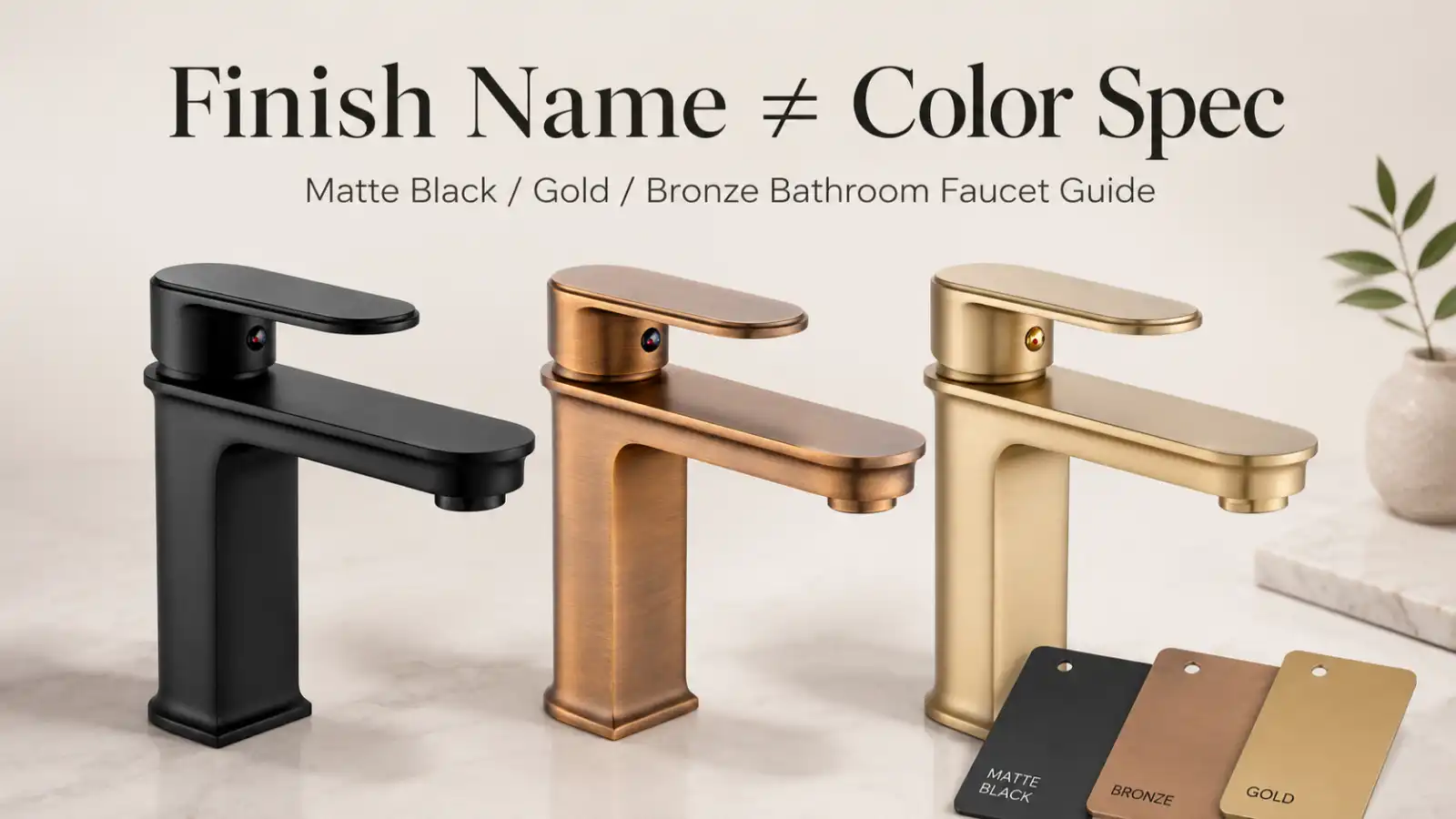
A bathroom faucet RFQ can contain one simple line:
Finish: Gold
The buyer has not made a mistake. Gold is a valid starting description, and buyers who contact us for a gold finish frequently already have a specific tone in mind. They send a reference image, identify a rose gold or brighter gold direction, or select from the physical color cards we provide.
Production still needs a physical reference.
This becomes more obvious when one bathroom combines a faucet, handles, shower fittings, towel hardware and a drain. Every catalog can describe those pieces as gold. Put them beside each other and the question changes from “Are they gold?” to “Are these the same gold?”
The same issue appears with matte black and bronze. A finish name identifies the visual family. Reproducing that appearance across another production run, or another supplier, takes more than the name.
“Gold” Has to Become Something We Can Keep
When a buyer asks us for a gold finish bathroom faucet, we start with our existing color cards.
Gold itself can include rose gold, bright gold and other tones. A reference photo helps narrow the direction, but we do not treat a phone or computer image as the production color standard.
Screens change brightness and white balance. Product photography changes the apparent warmth again.
Once the buyer selects a color card, a sample is the next useful reference for projects that need closer confirmation. We keep the approved color card used for that sample and pull it again when the bulk order enters production, tied to the PO number.
| Information in the inquiry | What production uses |
|---|---|
| Gold | A starting color family |
| Rose gold or bright gold | A narrower direction |
| Customer reference image | Used to identify the requested tone |
| Our physical color card | Physical color reference |
| Approved faucet sample | Visual confirmation of the finished product |
| Retained approved color card | Reference for bulk production and later orders |
A buyer who already knows the required tone does not need a lesson on gold terminology.
This also keeps later orders simpler. If the first batch used a retained reference, the next order doesn’t need someone to reinterpret “gold” from an old email attachment. The reference already exists.
Color Matching Is Settled Before Final QC
There is a common assumption that final inspection is where a factory decides whether the color is correct.
That is too late for our production flow.
Products from the same batch are finished together. The approved color card has already been fixed before that stage. When our QC team checks the finished pieces, the inspection focuses much more on visible defects — scratches, bubbles, surface imperfections. The color itself was decided earlier, at approval.
Different production batches still return to the same retained color reference. Small process variation can exist, but the color target does not change because a new batch has started.
Delta states in its own product materials that differences in the size, shape and material of individual faucet parts can create visible color variation even when color controls are in place. That’s a fact worth separating from the approval question. Whether the correct finish reference was used is one thing to check. Whether different parts — a spout, a handle, a flat escutcheon — reflect that same reference identically under light is another, and for a buyer assembling a complete bathroom program, the two shouldn’t get collapsed into one requirement called “gold.”
The Color Name Doesn’t Tell You the Surface Process
The process and the visual finish are separate specification lines.
Established finishing routes for faucet hardware include electroplating, PVD (physical vapor deposition), and powder coating, and manufacturers assign different routes to different finish families rather than one process per brand. The colors belong to familiar visual families. The production routes behind them are not interchangeable.
For our own products, painted finishes go through an outside specialist painting factory because of the environmental requirements around that process. Our other surface finishing is handled in-house.
We don’t present the finishing method itself as a special invention. These are established manufacturing methods.
The procurement point is narrower. If an RFQ says only Matte Black, Gold or Bronze, the buyer has specified an appearance family — not how the surface is made. For an OEM order where the process matters, put it on its own spec line.
A Finish Name Gets Less Useful When Parts Come From Different Catalogs
Public catalogs make the naming problem easy to see.
Moen lists names including Brushed Gold, Classic Gold, Brushed Bronze, Mediterranean Bronze, Old World Bronze and Oil Rubbed Bronze. Kohler lists finish families including Vibrant French Gold, Vibrant Brushed Moderne Brass, Vibrant Brushed Bronze and Matte Black, and its global finish materials note that availability can differ by market.
Those names work inside each manufacturer’s own product system. They don’t carry over cleanly for a buyer combining products from several suppliers.
Forum discussions show the practical version of the same problem. Buyers compare brushed gold with champagne gold, search for shower hardware to match champagne bronze, and sometimes get parts that read clearly more yellow than the faucet beside them. One buyer insists every piece should match exactly. Another accepts a small difference when the parts sit on opposite walls. Others sidestep the whole question by pairing the gold faucet with black or frameless accessories instead.
A purchase order needs a firmer rule than any of those opinions.
If several parts are meant to read as one finish family, approve them against a physical reference. If two metals are meant to be different, specify them as two finishes — don’t let an accidental near-match get called a design choice after the fact.
I don’t know how another supplier defines its own “brushed gold” reference. We can work against the physical reference approved for our order. We don’t make the drain, and we don’t certify another supplier’s drain or accessory as an exact match just because its catalog also uses the word gold.
Matte Black Shows Why Appearance and Surface Condition Should Stay Separate
Matte black generates a different kind of confusion.
A white mark shows up and gets called a finish problem. A black surface scratches and gets described the same way. Peeling, mineral deposits and cleaner damage can all land in one complaint even though they come from different mechanisms entirely.
Online discussion around hard water shows the same uncertainty. Some owners ask how to remove mineral buildup without damaging matte black. Others warn against acids or abrasive cleaners out of concern for the coating.
Official care guidance draws a cleaner line. Delta’s finish-care materials note that water left to evaporate on the surface can leave mineral deposits, and that hard-water stains can be removed with a diluted white-vinegar solution — while warning against harsh abrasives, strong acids and caustic cleaners on matte black specifically. Moen separates its cleaning instructions by finish type as well, with different care limits across its finish groups.
Those instructions belong to those manufacturers’ products; we don’t copy another brand’s cleaning guidance into our own warranty policy. What they do confirm publicly: the visible color doesn’t tell you how the surface reacts to every cleaner.
We had a March 2025 sample where paint peeled and corrosion showed up underneath. The cause traced back to stacked spray coats with weak adhesion. The fix added an electrophoresis base coat before the spray layer. That was a coating problem — a manufacturing defect. A white mineral mark sitting on an intact matte-black surface is a different event, and a buyer looking at a complaint photo should tell the two apart before deciding whether it’s a cleaning issue, a water-deposit issue, or the finish itself.
Matching a Bathroom Is Easier When the Reference Is Shared
A bathroom collection rarely stops at one faucet.
The visual field can include the faucet body, handle, shower components, towel hardware and a drain. Some components can follow the same approved color reference even when their manufacturing route isn’t identical.
A physical card is more useful here than a descriptive name. If a body and handle are both supposed to match the approved gold, each gets checked against the same reference. A separately sourced shower accessory gets matched against it too. The drain sits outside our production scope — if the buyer sources it elsewhere, its finish needs its own confirmation.
A slight difference doesn’t automatically read as a visible mismatch once everything is installed. Part geometry, texture and viewing distance all affect what the eye picks up, which is the same point the Delta reference above makes about individual parts. For close side-by-side parts, sample matching deserves more attention. For pieces installed farther apart, the buyer decides whether the physical samples are close enough for the project — we don’t replace that approval with a promise built on two identical catalog names.
The same rule applies to matte black and bronze. One continuous finish, one approved physical reference. A deliberate mix of black and gold, two finishes recorded separately.
Different Markets Change the Catalog Before They Change the Factory Reference
A “different markets” finish guide can easily drift into claims like one country preferring gold while another prefers matte black. We don’t have data behind claims like that, so we don’t make them.
What actually changes across international purchasing is the product catalog, finish availability, and the naming system each supplier uses. Kohler’s own global-finish materials list a defined set of international finishes and tell buyers to check local availability — which is enough on its own to create a sourcing headache. A buyer finds a finish in one regional catalog, then finds out another product line or market doesn’t carry the same option.
The physical approval process doesn’t need to change because of that. A North American buyer, a European buyer and a Middle Eastern buyer can call the same tone by different commercial names. Once an OEM color is approved for our order, our production reference stays the retained physical sample or card — market terminology lives in sales communication, not in production.
The PO Should Preserve the Approval Work
A weak finish line looks like this:
Finish: Gold
That’s enough for an early inquiry. It gets thinner after the buyer and supplier have already spent time selecting cards and approving samples.
A production PO can preserve that work instead:
Finish: Gold tone matching approved physical sample / retained color card [reference number]
If a specific surface process has also been agreed, add that as its own field. If a third-party drain needs to coordinate with the faucet, record it as a separate line rather than assuming its supplier defines gold the same way.
Matte Black identifies the appearance. The approved sample, the finish spec, and the agreed inspection criteria are what the factory actually builds to.
FAQ
Does a gold finish bathroom faucet have one standard gold color?
No. Public manufacturer catalogs use several distinct gold, brass and bronze finish families. For OEM production, a physical color card or approved sample is a more useful reference than the word gold alone.
Are brushed gold and champagne bronze the same color?
Don’t assume they are. Real bathroom-remodel discussions contain both claims — some buyers find the combinations close enough, others report visible undertone differences. For purchasing, compare physical samples.
Will a matte black bathroom faucet show hard-water spots?
Mineral deposits can remain after water evaporates on any faucet surface. Delta’s matte-black care guidance specifically addresses water spots and hard-water stains. A deposit on an otherwise intact surface shouldn’t get diagnosed as coating failure from a photo alone.
Do the faucet, shower hardware and drain need to match exactly?
That’s a project decision, but the PO should make it explicit. If they’re meant to match, approve them against a common physical reference. If they’re meant to differ, specify two finishes.
Does PVD automatically mean a gold faucet is better than a painted finish?
The process name alone doesn’t answer that. PVD, electroplating and painted or powder-coated surfaces are different manufacturing routes suited to different finish families. What the buyer actually needs is the approved appearance, the required test or quality criteria, and the correct process for that specific SKU.
Sources
-
Delta Faucet — Lahara Widespread Bathroom Faucet, Finish-Matching Q&A
Referenced for Delta’s statement that differences in the size, shape and materials of individual faucet parts can create visible color variation despite finish-control methods. -
Moen Solutions — Faucet Finishes
Referenced for named bathroom and kitchen finish families, the distinction between PVD, electroplated, powder-coated and multi-step powder-coated finishes, and finish-specific care guidance. -
KOHLER — Finish Program
Referenced for public finish-family naming across bathroom faucets, kitchen faucets, accessories and lighting, including Matte Black, Vibrant Brushed Moderne Brass, Vibrant Brushed Bronze and Vibrant French Gold. -
KOHLER — Statement Showering Collection Global Finishes
Referenced for KOHLER’s listed global finish set and its instruction to confirm finish availability in the buyer’s market. -
Delta Faucet — How Should I Clean or Maintain the Finish on My Faucet?
Referenced for mineral-deposit formation after water evaporates, removal of hard-water stains with a diluted white-vinegar solution, and warnings against abrasive, acidic, caustic and bleach-based cleaners. -
Delta Faucet — Matte Black Vessel Faucet Care Q&A
Referenced as a product-specific matte-black care example covering water spots, hard-water stains and finish-damaging cleaners. -
X-Rite — How Appearance Affects Color
Referenced for the effect of surface texture, gloss, geometry, illumination and viewing conditions on perceived appearance and color matching. -
Reddit / r/BathroomRemodeling — Brushed Gold Bathroom Fixtures
Discussion evidence only. Referenced for real buyer disagreement over brushed-gold / champagne-gold matching and whether small finish differences are acceptable when parts are separated in the room. Not used as an authority source. -
Reddit / r/HomeImprovement — Hard-Water Stains on Matte Black Fixtures
Discussion evidence only. Referenced for the real maintenance question around mineral deposits, acids and matte-black surfaces. Technical cleaning guidance in the article is anchored to manufacturer sources above. - HWFaucet internal production and specification notes. Referenced for customer color-card selection, reference-photo use, sample approval, retained color cards tied to later production, same-batch finishing, final QC focus on scratches / bubbles / surface defects, outside specialist painting, in-house handling of other surface finishing, March 2025 coating-failure review, drain supply boundary and OEM PO finish-reference workflow.