Here is how the two actually split on our line, lined up against what a buyer ends up checking at acceptance.
| What the buyer sees | Stainless, on our line | Brass, on our line |
|---|---|---|
| Spec line says | “stainless steel” | “solid brass” |
| What that word names | the body, or just the finish | the body |
| Wetted surface we run | SS201 or SS304 | brass waterway; H59 standard, H62 or higher on request |
| Pull-down / pull-out tube + spray hose | EPDM | EPDM |
| The lead answer | a leftover trace from smelting, not an added ingredient | a grade-and-certificate question, checked per SKU |
| Clears a given market when | that SKU carries the market’s certificate and test | same |
| Where durability lives | wall, finish, cartridge, hose | wall, finish, cartridge, hose |
The metal name only fills the top of that table. What a buyer gets held to sits lower down.
What “stainless” and “solid brass” actually describe
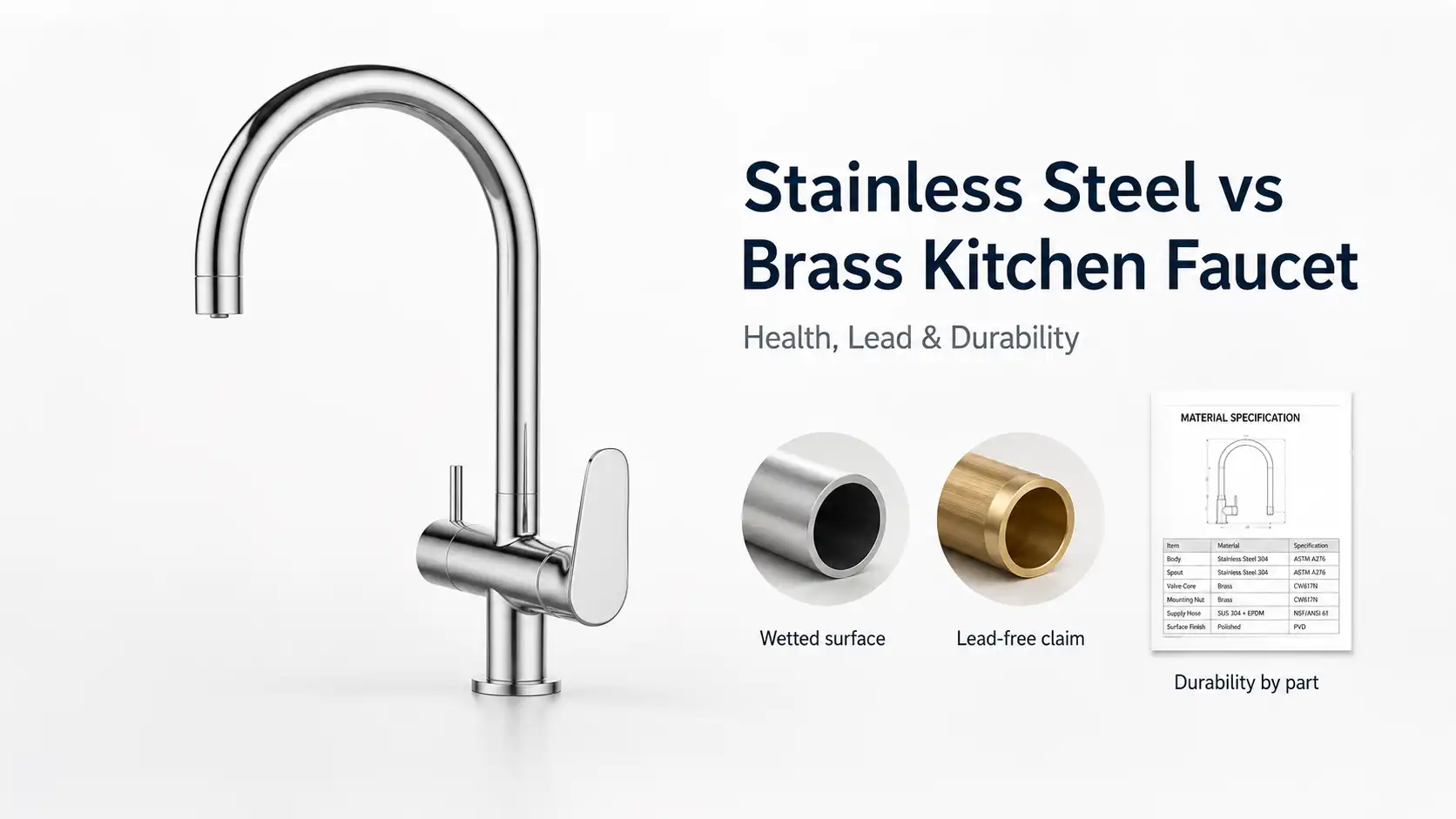
A spec line reading “all stainless” or “solid brass” is describing the body, sometimes only the finish sitting over it. The parts that move water — spout, spray head, cartridge seat, hose, mounting hardware — can run other materials, and a faucet sold as stainless can still carry a brass or polymer part in the path. We broke that down part by part in our materials guide; here it’s enough to treat the word on the box as a body-and-finish label.
On our line the split is plain. A stainless faucet carries SS201 or SS304 on the surface the water touches. A brass faucet carries a brass waterway. In both, the pull-down or pull-out tube and the spray hose are EPDM. So “stainless” on one of our SKUs points at the wetted tube, while “stainless” as a finish on some other product might point at nothing in the water path at all.
For a buyer, that gap decides what goes into the spec: you name the wetted material, not the marketing word.
“Lead-free” is a calculation, not “no lead”
Under the US Safe Drinking Water Act, “lead-free” is a number, not a yes-or-no. It means a weighted average at or below 0.25% lead across the product’s wetted surfaces. Solder and flux carry a separate limit, 0.2%. The average is worked part by part: each wetted component’s lead content times its share of the total wetted area, added up. A product can land under 0.25% on that average and still hold a small part carrying more lead than the headline number hints.
So “lead-free” was never a promise of zero. The EPA names brass and chrome-plated brass faucets as a common lead source in homes with no lead service line. The same rulebook still clears a certified lead-free brass faucet for drinking water. Both are true at once.
The marks behind the label answer different questions, and buyers run them together. NSF/ANSI/CAN 372 covers lead content. NSF/ANSI/CAN 61 covers what can leach out of the material into the water, and since October 2017 a 61 listing pulls in 372 underneath it. A SKU marked to 372 alone has cleared the lead-content question; a SKU marked to 61 has cleared the leachate question too.
I had this exact conversation at the Canton Fair in March 2026. A buyer I’d been talking with for a long while came by the booth — selling into Israel, told me up front he didn’t need a UPC listing, kept circling back to lead-free. We pointed him at a few of our better-selling SS304 models. He asked whether lead-free meant 100% no lead. It doesn’t: in SS304 the lead is a leftover from smelting, sitting far under the level anyone tests against, not an ingredient added to the alloy. For a brass SKU that same question runs through the grade and the certificate instead — one SKU at a time.
What a PO should pin — and where we come in
A PO line that reads “solid brass, lead-free” hands the factory a blank to fill. It doesn’t say which wetted material, which SKU the certificate actually covers, whether the mark is 61 or 372, or which test report stands behind it. Each blank is a place the order can stall.
Our certificates are issued per SKU, not stamped across the whole catalog. The kitchen faucet line carries a UPC listing; most of our models carry CE. Read one certificate, assume it covers every line in the quote, and the gap surfaces at the worst time. Maybe at your own compliance check. Maybe with the goods already at the port.
When an RFQ reaches my desk, the first thing I send back is one question: which market is this selling into. We quote against that market’s requirement and tell the buyer in writing that the quoted build already meets it. That matching is the piece we carry for procurement. We line up the SKU, the wetted material and the certificate against the destination before the PO is cut. The spec you sign is the spec that clears.
Skip the market question and the rest follows. A build gets quoted that won’t clear, packaging gets printed against a claim that won’t hold, and the timeline slips while it’s re-tested or re-sourced.
The same faucet does not clear two markets the same way
The US rule weighs lead across the wetted surfaces and asks for that 0.25% average. The EU starts from the alloy. Under Article 11 of the recast Drinking Water Directive, its positive list judges lead-bearing alloys — brass, bronze, gunmetal — by what the alloy itself is made of, not by an average across wetted area. At the tap, the EU lead limit drops from 10 to 5 µg/L. New products meet it from 31 December 2026; products already on the market run on a transition out to 2032.
The two rules measure different things. The US figure is an average spread across how much wetted area each part contributes. The EU figure is a ceiling on the alloy. A brass waterway that lands fine under the US weighted average isn’t automatically fine against a 0.1% alloy cap — different yardsticks, so a SKU cleared for one isn’t cleared for the other by default.
China and Russia each run their own water-contact requirements on top of that. We make both stainless and brass bodies for a working reason. A buyer needs a body and waterway that match the destination market’s water-path certification. Set the market, and the brass-or-stainless call mostly makes itself.
Launching into two markets at once changes the order of work. Lock the wetted material and the certificate for each market first. Settling them after the packaging is designed is how a timeline slips.
What “no plastic parts” misses
Buyers ask for all-metal internals as a quality screen. On a faucet it screens out the wrong things. The cartridge rides on a ceramic disc; the seals are EPDM or POM; the spray hose runs an EPDM liner. Those aren’t the cheap stand-in for metal — they’re what holds up against pressure cycling and the hot-cold movement where a metal part would wear or seize. The part of an all-metal spec worth holding to is the body and the waterway — the surfaces under pressure and in contact with water. Demanding metal there is fair; demanding it at the cartridge seal trades reliability for a word on the spec sheet. For a buyer comparing two quotes, the screen worth applying is which parts are metal where it counts, which is the same logic behind how we size and spec a single-handle cartridge.
RO and low-pH lines change the math
We do RO and drinking-water faucets, though not as a separate range — they come through on the same kitchen faucet platform. That matters because of how aggressive water behaves.
The EPA is plain about it: water with low pH or low mineral content corrodes plumbing and draws more lead out of it. So on a filtered or RO tap the wetted material and its certificate weigh more. Soft, acidic supply is where a stainless wetted surface or a certified lining earns its cost. On ordinary water, speccing 100% stainless through every part buys headroom the job won’t use.
What we stand behind is the build and the test bench. Incoming brass and stainless arrive with the supplier’s material test report. We don’t take that at face value. We pull samples, run them on a spectrometer, and check the reading against what was promised. Finished faucets go through an in-house corrosion run, 24 hours on the acidic test or 72 on the neutral one. Cartridges get a 48-hour life test mounted on a working faucet, a machine opening and closing the handle, rather than a number on a cycle sheet.
What we don’t do is sign off your local water chemistry or your site’s plumbing. We build the faucet and we test it; the water that runs through it after install is yours to know. For a market I haven’t quoted before, I’d pull the certificate and re-read the wetted-surface list before putting any lead-free claim in writing — I won’t read it off the model name.
Durability lands in the parts, not the name
Durability comes down to the same kind of detail — wall thickness, finish, cartridge, hose — each judged on its own, which is exactly the part-by-part breakdown in our materials guide. Pick the market first, pin the wetted material and the certificate to the SKU, and the brass-or-stainless line on the quote stops being the thing worth worrying about.
If you have a target market and a model in mind, send it over and we’ll tell you what it takes to clear there.
FAQ
Is a stainless steel kitchen faucet safer than a brass one?
Neither is safer by name. It comes down to the wetted-surface material and the certificate behind that SKU. A certified lead-free brass faucet and a stainless one can both be fine for drinking water; an uncertified version of either isn’t something to assume on.
Does “lead-free” brass mean zero lead?
No. Under the US rule it means a weighted average at or below 0.25% lead across the wetted surfaces — not none.
What’s the difference between NSF 61 and NSF 372 on a faucet?
NSF/ANSI/CAN 372 is about lead content: whether the product meets the 0.25% weighted-average limit. NSF/ANSI/CAN 61 is about leachate — what can migrate from the material into the water — and since October 2017 a 61 listing also requires 372 underneath it. A SKU marked to 372 alone has answered the lead-content question; one marked to 61 has answered the leachate question as well. When a buyer asks for “lead-free,” the thing to check is which of these marks the SKU actually holds.
Is a stainless steel finish the same as a solid stainless faucet?
No. A stainless-look finish can sit over a brass body. The finish is a surface; the wetted material underneath is what matters for water.
Can one brass kitchen faucet be certified for both the US and EU?
Only if that SKU’s wetted material and certificate clear both the US weighted-average rule and the EU 0.1% alloy cap, which measure lead differently. Confirm per SKU and per market, and ask before the PO is cut.
Sources
- U.S. Environmental Protection Agency — Use of Lead Free Pipes, Fittings, Fixtures, Solder, and Flux for Drinking Water Referenced for the US lead-free rule, including the 0.25% weighted average across wetted surfaces, 0.2% solder and flux limit, certification requirement, and exemptions.
- 42 U.S.C. § 300g-6 — Prohibition on use of lead pipes, solder, and flux Referenced for the statutory definition of “lead free” and the wetted-surface calculation method.
- EPA — How to Identify Lead Free Certification Marks for Drinking Water Products Referenced for certification mark guidance and the relationship between NSF/ANSI/CAN 61 and NSF/ANSI/CAN 372 after the October 2017 update.
- NSF — NSF/ANSI/CAN 61 Testing and Certification Referenced for NSF/ANSI/CAN 61 as a drinking-water system component health-effects standard for materials, components, products and systems in contact with drinking water.
- NSF — NSF/ANSI/CAN 372 Technical Requirements Referenced for NSF/ANSI/CAN 372 as the lead-content standard and methodology for drinking-water system components.
- EPA — Basic Information about Lead in Drinking Water Referenced for EPA statements on lead entering drinking water through corrosion, especially under high acidity or low mineral content, and on brass or chrome-plated brass faucets as a common source in homes without lead service lines.
- EUR-Lex — Directive (EU) 2020/2184 on the quality of water intended for human consumption Referenced for the EU drinking-water framework, Article 11 material-contact approach and lead parametric value transition.
- EUR-Lex — Commission Implementing Decision (EU) 2024/367 Referenced for the European positive lists of materials and compositions authorized for products that come into contact with water intended for human consumption.
- Wavin — How to comply with new EU law on lead in drinking water Referenced as an industry explanation of the EU positive-list implementation timeline and the 0.1% lead limit for lead-bearing alloys such as brass, bronze and gunmetal.