Most single handle bathroom faucet complaints have nothing to do with the handle.
A single handle bathroom faucet puts hot, cold, and flow on one lever, mounted on a vanity, a single hole vanity faucet. The trouble lands somewhere the order never specified. The faucet won’t fit the holes. The cover plate won’t seal. The water splashes past the basin. The drain leaks or won’t seat. The flow fails the local rule. Each one points back to a line that should have been pinned before the PO.
Start with the holes that don’t line up
The faucet arrives and won’t sit right on the sink. That starts with a word mix-up. One handle is a count of levers. One hole is a count of holes drilled in the deck. They are set independently. A single-handle faucet can mount in one hole. It can also sit over a 4-inch centerset with a cover plate, or share a deck with a widespread layout, where the holes run 6 to 12 inches apart.
A cover plate hides the spare holes. It does not re-drill them or move them. On a curved deck, or where the holes sit wider than the plate, the plate can rock or leak instead of sealing flat. A minimalist single-hole design ships without a plate. Order one for a 3-hole basin and there is nothing to bridge the gap.
How thick a deck the faucet can clamp is its own number, the one we worked through in the single-hole sizing guide. Here the point is plainer: order to the hole layout that exists, name the plate, and confirm the basin before the PO. On a single handle bathroom faucet replacement, the existing hole count decides what fits, so check it before the model.
The drain kit is the line the install actually leaks through
The supply lines, the gaskets, the fixings travel with the faucet. The drain often does not. On our line the standard set is two 60-centimetre supply hoses, the washers, and the fixings. The drain is not in that box. We do not make drains, and most of our faucets skip the lift rod. A lift rod means another hole drilled through the body. A buyer who assumes the drain comes with the faucet finds out at install.
So the drain is a line of its own on the order. Someone supplies it: the buyer, the sink maker, or us as a custom add. Leave it unnamed and the install stalls.
It also has to match the basin. An overflow basin needs an overflow drain; a no-overflow basin needs a no-overflow one. A basin with an overflow hole takes the overflow-style drain, which routes the overflow water down. A vessel or semi-recessed basin with no overflow takes the no-overflow drain. Fit the wrong one and the basin either leaks from the overflow or never clears it. They are sold as two separate parts for that reason.
The connection size is standard. A bathroom basin drain runs a 1-1/4 inch tailpiece in most markets, so it mates with a standard trap. The variables a buyer still sets are the type, the stopper, and whether there is an overflow. We make those to order. We do not stock a default drain and slip it in unannounced.
The stopper is its own small choice. A push, spring-loaded stopper needs no rod. A rod-operated pop-up needs the extra hole and the linkage. We build the rod version only when a model calls for it.
Splash is a reach-and-height problem
Water hits the back of the basin, or sprays off the front, or never reaches the bowl. That is geometry, not a faulty faucet. Two numbers set it: how far the spout reaches out, and how high the outlet sits above the basin.
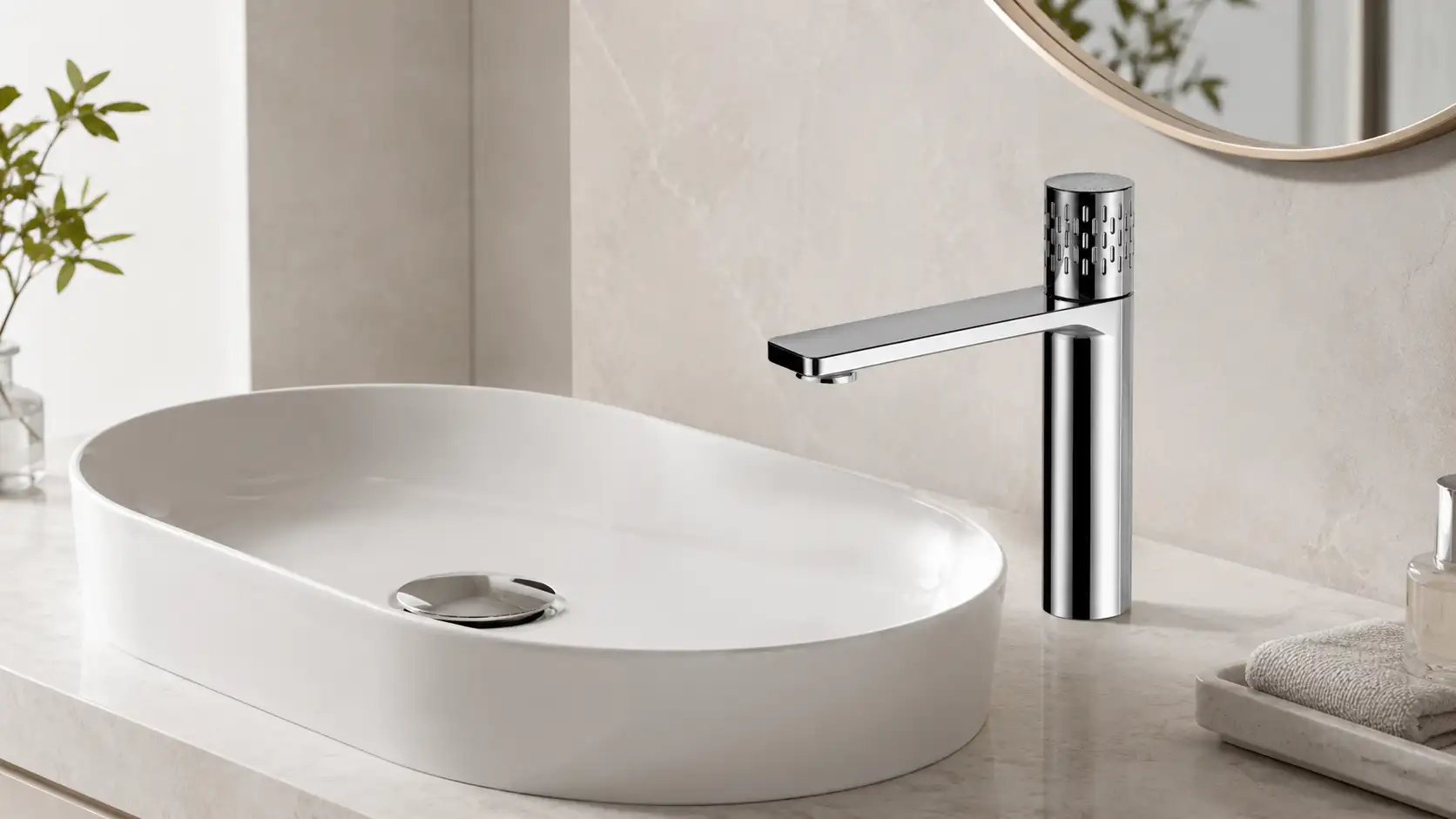
Our basin faucets run from about 6 centimetres of height on the low models to around 20 on the tall ones. A tall spout over a shallow basin drops water from height and throws spray. A short spout over a wide basin lands the water on the rim instead of the drain. The basin and the faucet get matched, not picked apart.
The spray itself is set by the aerator. The aerators we fit have an anti-splash pattern, and we buy them in rather than make them. They soften the stream and keep it landing where it should. A buyer chasing a tall profile without checking reach against the basin is ordering the splash along with the look.
The same faucet fails a different rule in each market
A single-handle basin faucet can pass in one market and get pulled in another, on flow alone. The number is set by where it ships, not by the spout.
The cartridge passes water at a rate the user never sees directly. Our 35-millimetre cartridge flows around 10 litres a minute on its own. The aerator brings that down to the local limit. In the United States the federal cap on a lavatory faucet is 2.2 gpm, about 8.3 litres a minute. The WaterSense label needs 1.5 gpm or less, about 5.7 litres. California and several other states require 1.2 gpm, about 4.5 litres, and the WaterSense draft revision moves toward 1.2 as well. The flow tests run to ASME A112.18.1 and CSA B125.1. So the same body ships with a different aerator per market, and the cartridge underneath stays the same.
The inlet thread changes too. North America runs NPT; most of Europe, Asia, and Australia run BSP, and the two do not seal to each other. The lead, wetted-surface and certificate side sits in the stainless vs brass guide. The drain follows the same logic: a market that mandates an overflow basin needs the matching overflow drain.
A finish swap clears none of this. Flow, thread, drain type and certificate are each their own line.
What we run as standard, and the lines an RFQ should pin
Polished is the standard finish on nearly every model, with brushed, PVD, and lacquered on request. The cartridge is ceramic, in 35 or 25 millimetre, and the spare-parts logic for it sits in the single-handle cartridge guide. The standard accessory set is the two supply hoses, washers and fixings. The drain is not in it.
When a basin faucet RFQ reaches my desk, the answer starts with the lines that decide the install, before the finish. The ones worth pinning:
- hole layout: single, 4-inch centerset, or widespread, and whether a cover plate ships
- spout reach and outlet height against the actual basin
- drain: who supplies it, overflow or no-overflow, stopper type
- flow and aerator for the destination market
- cartridge size and spare plan
- inlet thread for the market
What we commit to is plain. We confirm each line with the buyer at order. We build only after the spec is signed off, and we test before it ships. We do not supply a drain we did not quote, and we do not decide a buyer’s market rule for them. For a destination I have not shipped to before, I would confirm the flow limit and the certificate scope before the build goes in writing. Our basin faucet range runs on that set.
Closing
On a basin faucet, every complaint above has a spec line behind it, and the handle is rarely the one. Pin the holes, the reach, the drain, and the flow for the market, and the faucet stops failing at install. If you have a basin and a market in mind, tell us, and we will lay out the lines that decide it.
FAQ
Is a single handle bathroom faucet the same as a single hole faucet?
No. One handle counts levers; one hole counts the holes in the deck. A single-handle faucet can go in one hole, or over a 4-inch centerset with a cover plate.
Does a single hole faucet come with a deck plate for a 3-hole sink?
Not by default. Many minimalist single-hole faucets ship without a plate. If the basin has three holes, name the deck plate on the order, or the spare holes stay open.
Does a bathroom faucet include the drain, and overflow or no-overflow?
On our line, no. The standard set is supply hoses, washers and fixings; the drain is a separate line. It has to match the basin. An overflow basin needs an overflow drain. A vessel or no-overflow basin needs a no-overflow one. The tailpiece is a standard 1-1/4 inch, and we make the drain to order.
What spout reach keeps water landing in the basin?
Match the reach to the basin width and depth. Our models run from about 6 to 20 centimetres in height. A tall spout over a shallow basin throws spray. A short one over a wide basin lands water on the rim. The anti-splash aerator helps, but the reach has to suit the basin first.
What flow rate does a bathroom faucet need by market?
In the US, the federal cap is 2.2 gpm; WaterSense needs 1.5 gpm or less; California and several states require 1.2 gpm. The aerator sets the faucet to the market, and the cartridge underneath stays the same.
Sources
- U.S. EPA WaterSense — Bathroom Faucets Referenced for WaterSense private lavatory faucet scope, the 1.5 gpm label limit, the 2.2 gpm standard flow comparison, and the February 2025 pause on Draft Version 2.0 work.
- U.S. EPA WaterSense — Private Lavatory Faucet Specification Background Materials Referenced for the private lavatory faucet specification context, faucet performance and certification background.
- U.S. DOE / eCFR — 10 CFR Part 430, Energy Conservation Program for Consumer Products Referenced for federal appliance-efficiency framework covering consumer plumbing products, including faucet flow requirements.
- ASME — ASME A112.18.1 / CSA B125.1 Plumbing Supply Fittings Referenced for the plumbing supply fitting standard named in the flow-test section.
- California Energy Commission — Appliance Efficiency Regulations Referenced for California appliance-efficiency context and state-level product-efficiency requirements.
- Lowe’s — Bathroom Sink Faucets Buying Guide Referenced for common bathroom faucet hole-layout terminology, including single-hole, centerset and widespread configurations.
- Delta Faucet — How to Install a Single-Handle Bathroom Sink Faucet Referenced for single-handle faucet installation over one-hole or three-hole configurations using an escutcheon plate.
- The Spruce — Understanding the Plumbing of the Bathroom Sink Referenced for bathroom sink drain tailpiece and under-sink drain component terminology.
- The Spruce — What a Sink Overflow Hole Is Referenced for the overflow-versus-no-overflow basin distinction and how overflow channels route water into the drain.
- HWFaucet — Single Hole Faucet Sizing Guide Internal reference for deck thickness, deck plate coverage and hole sizing logic.
- HWFaucet — Single Handle Faucet Cartridge Guide Internal reference for cartridge size, single-handle service risk and spare-parts logic.
- HWFaucet — Stainless Steel vs Brass Faucet Waterway Guide Internal reference for wetted-surface material, lead-free claims, thread and certificate scope by market.