| Step | What’s decided | If it doesn’t line up |
|---|---|---|
| Cartridge type | ceramic or brass | feel, wear over time |
| Cartridge size | 35 mm (most), 25 / 40 mm | how easily a spare is found |
| Hot/cold orientation | left = hot (IRC); forward-back varies | temperature reads reversed |
| Handle marking | red / blue, H / C | the user guesses |
| Supply-tail marking | red / blue on the hoses | the fitter wires to habit, then reworks |
Where one handle helps, and where it costs
One handle earns its place through use. A wet or full hand nudges a single lever; two handles need a clean grip on each. For an aging-in-place or accessible project, that one-hand, even elbow-friendly action is the reason to spec it.
The cost is the other side of that coin. One cartridge carries flow and temperature, so when it wears, the whole faucet goes off until it’s swapped. A two-handle build can limp on one side while the other waits for a part.
The cartridge, in one pass
Ceramic versus brass is covered everywhere, so take it as read. What a buyer services later is the cartridge size, the base, and the spare plan — so that is where this stops. We run ceramic cartridges for faucets and brass cartridges, and pick by the model and its use.
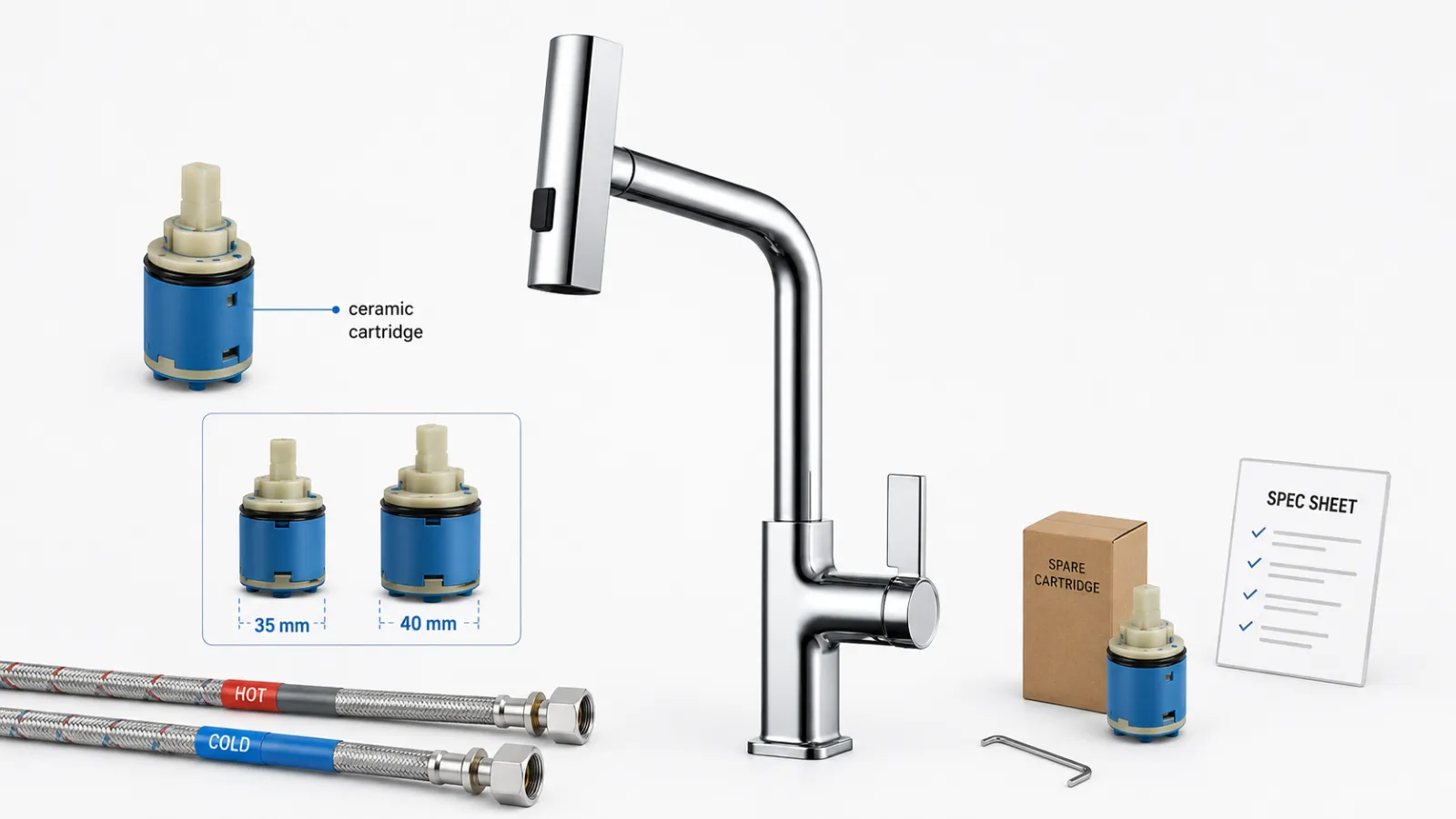
Size is where a buyer’s later life gets decided. Our cartridges come in 35, 40, and 25 mm, and 35 mm is the one we fit most — for no reason past it being the size the trade stocks. A faucet built for a 35 mm cartridge takes a 35 mm cartridge from more than one maker, if the base matches. Pick an odd size, and a customer in year eight is hunting a part that few shelves carry.
We don’t make cartridges. We buy them, and we ask the cartridge plant for a cycle-test report on the batch. When a batch lands, we run it on a pressure tester for a 48-hour open-close cycle. The batch goes into faucets only if it comes through clean.
The cartridge is not fixed to one model, either. In 2025 an Israeli buyer sent an RFQ: meet the UPC standard, but no UPC certificate needed — UPC isn’t mandatory in his market. He knew the standard, and so did we, since we already build UPC faucets. He wanted a cold-start cartridge for the energy rating, and we fitted a UPC-compliant cold-start cartridge to suit. One spec, one swap; the body didn’t change. A cold-start cartridge centres on cold, so a lever pushed straight up draws cold water instead of warm. The market wanted it to stop the water heater firing on a quick rinse — an energy rule written into the cartridge.
Hot, cold, and the chain that fails on a project
Marking the handle right is the part everyone gets. North American code reads left as hot when you face the outlet (IRC P2722.2). A single lever carries a red and blue mark to match. The forward-back single-handle has no code behind it — about half ship hot-forward, half hot-back.
On a municipal project order in 2019, the chain broke past the handle. The buyer’s drawing put hot marked inside, cold outside; before we laser-etched the handles, he emailed to swap them — cold inside. We made the change, no issue: a mark in the wrong spot only means crossing the supply lines at install. But this was a town-scale job, and the fitters wired hot to the inside tail by habit, the way they always had. Everything was plumbed before anyone tested it. The test found the temperature reversed across the job, and the crew reinstalled the lot. After that, we mark the supply tails red and blue to match the handle, so a fitter reads the faucet, not his habit.
Which way a given crew wires the tails, I can’t set from the factory — the marking is the most I can hand them.
Spares, the quiet part
A cartridge is the one part of a single-handle faucet that gets replaced in service. A buyer should think about it before the order, not after a drip.
On our side the cartridge is a fitting. We don’t carry it as an SKU, and we don’t sell it on its own. Instead we bundle one to two percent spare cartridges with a shipment, and supply a hex key. A customer can pull and swap one without a service call. The 35 mm size does the rest of the work, since a common cartridge is one a buyer can still source years out.
What to pin, and what we are
We are a faucet manufacturer reading the specs importers and project buyers send over. We build to them; we don’t sell DIY retail, we don’t stock cartridges as a line, and we don’t wire the tails on site. What we put numbers on is the faucet — cartridge type and size, the markings, and the spare it ships with.
Names shift by market — single-handle faucet in North America, single-lever mixer tap in the UK, Europe, and Australia. The connection runs NPT or G/BSP to suit. Handle count is not hole count. A single-handle faucet can sit in one hole or over a deck plate, which our single-hole install and sizing guide lays out. It can also carry a pull-down or a separate side sprayer, added as a configuration on top of the one lever.
Our kitchen faucet range is single-handle first, ceramic or brass; a single-handle pull-down or pull-out sprayer runs the hose the way our pull-down kitchen faucet guide covers. The team that reviews a project spec is on the contact page.
FAQ
What is the difference between a single handle and a single hole kitchen faucet?
Handle count versus hole count. A single-handle faucet has one lever, and it can mount in one hole or, with a deck plate, over three. The two specs are separate.
Are single handle kitchen faucets better than two handle faucets?
Neither wins outright. One lever is faster and has less on the deck to leak; two handles give finer hot-cold control and a traditional look. Pick by how the sink gets used.
What cartridge type does a single handle kitchen faucet use?
A ceramic disc cartridge, or sometimes brass. We fit both, in 35, 40, or 25 mm, with 35 mm the size we use most. The model and its use set the choice.
Why does my single handle kitchen faucet drip after I shut it off?
The cartridge is the first thing to check. A worn ceramic disc drips, but so can a tired O-ring, a seat with grit, or debris in the line. Swapping the cartridge before checking those can leave the drip in place.
Are faucet cartridges universal?
By size and base, partly. A 35 mm flat-base cartridge can replace another 35 mm flat-base, but a different size or base will not drop in. Match the size, the base, and the stem.
Why are hot and cold reversed on a single handle faucet?
The supply lines, more than the faucet. North American code puts hot on the left at the outlet (IRC P2722.2), so a backward read points to crossed tails at install. Swap them, or check the cartridge orientation.
What is a cold-start single handle kitchen faucet?
One whose cartridge centres on cold, so lifting the lever straight up gives cold water instead of warm. It keeps the water heater from firing on a short rinse, which some markets want for energy rules.
Is a single handle faucet easier to use with one hand?
Yes. One lever moves with a wrist, a wet hand, or an elbow, which is why accessible and aging-in-place projects favour it. Two handles need a grip on each side.
Sources
- ICC — 2015 International Residential Code, Section P2722.2 Referenced for the rule that the left-hand side of the water temperature control represents hot water when facing the outlet.
- Structure Tech — Kitchen faucet hot/cold forward or backward Referenced for field confusion around forward/back hot-cold direction on single-handle kitchen faucets.
- Moen — Hot and cold reversed on a one-handle kitchen / bathroom faucet Referenced for the difference between reversing a 1225 cartridge stem and reversing supply lines on 1255 or 4000 cartridge models.
- Delta Faucet — Kitchen leaks: single-handle cartridges Referenced for the point that single-handle kitchen faucets can use different valve and cartridge part types, not one universal cartridge.
- Kerox — Cartridges Referenced for single-lever ceramic mixing cartridge families including 25 mm, 35 mm and 40 mm options.
- Kerox — K-35 single-lever ceramic mixing cartridge Referenced for a 35 mm single-lever ceramic mixing cartridge controlling volume and temperature, with base and locating-pin options.
- hansgrohe — CoolStart faucets Referenced for cold-start logic where the center handle position runs cold water and hot water flows only when the lever is moved intentionally.
- The Home Depot — How to replace a cartridge in a faucet Referenced for cartridge removal, retaining nut / retaining clip variation and manufacturer-instruction checks during cartridge replacement.
- StarCraft Custom Builders — Faucet valves and cartridges Referenced as background for 35 mm and 40 mm cartridge sizing, cross-compatibility boundaries by size and base, and common single-lever cartridge makers.