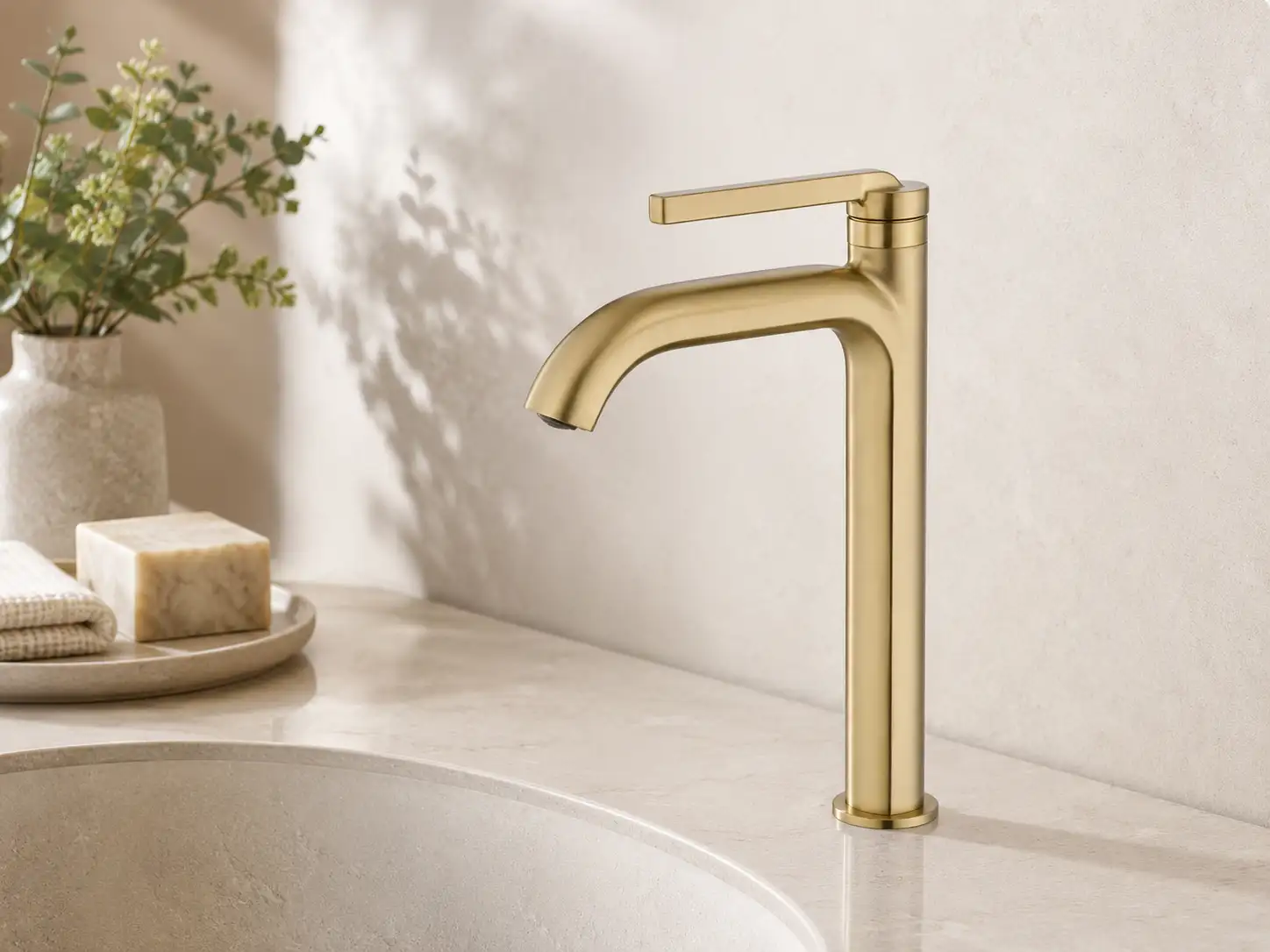
Most of what gets reported as a problem on an unlacquered brass faucet is the finish doing what it was built to do. A smaller set of complaints points at a real defect. Telling the two apart settles whether a claim gets paid or refused. It also decides what a buyer should write into the order up front.
| What you see | Looks like | Usually | Shows up first |
|---|---|---|---|
| Even darkening, warm tone | brown-gold deepening | by-design aging | the whole body |
| Green flecks | green spots | by-design, moisture-driven | spout base, aerator, wet zones |
| Black or grey smudging | dark patches | by-design, oils and air | handle, lever |
| Bright worn spots | shiny patches | by-design, touch wear | where hands grip |
| White cloudy film | dull marks | water minerals, not the finish | under the spout |
| Flaking or peeling layer | finish lifting | defect: it was coated, not bare brass | edges, transitions |
| Pitting, corrosion eating in | rough, irregular | defect: base metal or barrier failed | anywhere, uneven |
The last two rows are the ones a buyer should treat as faults for finish complaints.
Why an unlacquered brass faucet changes
Unlacquered brass is the bare metal of the faucet, polished or brushed, with no lacquer, clearcoat, or sealant over it. Copper sits in that alloy. Copper reacts with air, moisture, skin oils, and cleaning splashes. So the surface darkens, warms, and turns green in the wet spots.
The faucet ships bright. The change starts after it is installed and used. That is the part buyers miss: unlacquered is not pre-aged. A pre-aged look is a different finish, set at the factory and mostly held there. We covered it in the antique brass guide. Raw unlacquered keeps moving for as long as it stays in service.
The patterns buyers report as problems
The green flecks worry people the most. They show up first at the spout base, around the aerator, and anywhere water sits. Copper plus moisture makes a green film. On a living finish that is ordinary surface change, not rot in the body.
Black and grey smudging lands on the handle and the lever. Skin oils and air do that. It wipes back partway and then returns.
The look goes uneven on purpose. Grip points stay brighter because hands rub them. Recesses and the back of the spout go darker because nothing touches them. A buyer expecting one flat tone reads this as a fault. It is the finish living.
A white, cloudy film under the spout is a separate thing. That is mineral scale from the water, not the brass changing. It wipes off.
None of that is a warranty matter. The real faults look different.
The two failures that actually are defects
A coat that flakes or peels was never bare brass. Flaking is a coating coming loose from the metal under it. It traces back to a surface too dirty to bond, contamination between coats, or layers that do not hold together. Bare unlacquered brass has no coat, so it has nothing to shed. If a “brass” finish lifts in sheets at the edges, it was painted or plated, and the bond failed.
Pitting is the other one. The surface gets eaten in small, irregular craters, and the corrosion works inward instead of sitting on top. That points at the base metal or a failed barrier, not at normal aging.
A buyer brought a sample to our bench in March 2025. The paint had peeled and the brass under it was corroding. Our team traced it to stacked spray coats with weak adhesion. We run an electrophoresis base before the spray for that reason, so the coat grips instead of sitting loose. Either way, the rule for a buyer holds: even surface change is the finish; flaking and pitting are the metal or the coating failing. The split between body, plating, and waterway sits in the materials guide.
Why the process decides the failure mode
What fails, and how, comes down to the surface underneath rather than the color name.
| Surface | Coating | How it changes | Sample-matchable | Finish warranty (our line) |
|---|---|---|---|---|
| True unlacquered brass | none | changes continuously, by design | only the day it ships | none on our line; public living-finish exclusions exist |
| Lacquered brass | e-coat base, then spray | stable until the coat wears, then uneven | yes, at shipment | 5-year function, 2-year appearance |
| PVD brass-look | ion-bonded layer | holds color, no tarnish | yes | full, durable |
| Polished brass (our standard) | none, mechanical, anti-oxidation treated | stays bright with normal handling | yes | per finish |
PVD clears our salt-spray bench, 24 hours acidic and 72 hours neutral. True unlacquered would not, because reacting is the whole idea.
A living finish cannot be locked to one sample
A living finish keeps changing while it sits in a box. Packing, storage, handling, and humidity all touch it. A unit can arrive with a few spots on it already, straight out of the carton. So a physical sample shows one thing: the surface on the day it left the line. It cannot show the surface three months into use, because that surface does not exist yet.
For a coated or treated finish, a sample holds. For true unlacquered, it does not. A buyer signs off on a sample, then expects every unit to match it for years. That holds the order to a standard the finish cannot meet. The better move is to get the maker to state, in writing, that change is expected, and to define which changes count as faults.
What we run as standard, and how a custom unlacquered order works
Polished brass goes on nearly every model we make. Brushed, PVD, and lacquered come on request. Our unlacquered brass kitchen faucet runs on that set, all of it sample-matchable and warrantable.
True unlacquered is not on that list. When a buyer asks for it, we point to PVD first. PVD gives the warm brass look, holds its color, and matches a sample. If the buyer still wants true unlacquered, we make it as a custom order, with a minimum of 500 pieces. Before the order, we put three things in writing. The finish oxidizes and darkens. It needs periodic polishing to stay bright. And it carries no finish warranty, because no sample can lock its final look.
That high minimum comes from experience. One buyer confirmed true unlacquered in writing, signed off, and ordered. Then the oxidation complaints came in from their own customers, steadily, and the buyer asked us to stop the surface from changing. There is no fix for that other than periodic polishing, which is what we had named up front. We keep the email trail for exactly this reason, and we walk a new buyer through it before anything is cut. For a market with its own return-label wording, I would check the local rule before putting any of it into the order document.
What we commit to is plain. We match and warrant coated and treated finishes. We make true unlacquered on request, and we say in writing what it will and will not do.
Closing
On an unlacquered brass faucet, the finish color matters less than the line between normal change and a fault. Settle that line in writing before the PO. Pick a finish that matches how the buyer wants to handle the surface, and the complaints stop being surprises. If you have a market and a model in mind, tell us, and we will lay out which finish fits and what each one is held to.
FAQ
Why is my unlacquered brass faucet turning green?
Copper in the brass reacts with moisture, and the result is a green film. It shows up first at the spout base and anywhere water sits. On a living finish this is ordinary surface change, not corrosion of the body. It wipes back partway.
Is uneven patina or dark spotting a defect?
No. Uneven tone and dark patches are the finish reacting to touch and air. The defect line is different: flaking or pitting.
How do I slow down tarnishing on unlacquered brass?
Periodic polishing with a brass cleaner brings back the shine. A carnauba wax coat slows the change between polishes. For routine cleaning, mild soap and water is enough. Skip abrasives, ammonia, and bleach. On acids like vinegar, finish makers disagree, so follow the care sheet that comes with your finish. None of this stops the aging fully. It only paces it.
Is unlacquered brass safe for drinking water?
The finish is the outside surface. Soft or acidic water pulls more out of the metal. Drinking-water safety is about the wetted surface and the lead rule, which is a separate question. A brass faucet meets it through its grade and certificate, covered in the stainless vs brass guide.
Can I order a custom unlacquered brass faucet, and what isn’t guaranteed?
Yes, as a custom order, with a 500-piece minimum. What is not guaranteed: the finish carries no warranty. It will oxidize and need periodic polishing. No sample locks the final look. We put that in writing before the order.
Sources
-
- U.S. Environmental Protection Agency — Use of Lead Free Pipes, Fittings, Fixtures, Solder, and Flux for Drinking Water Referenced for the drinking-water FAQ and the separation between outside finish and wetted-surface compliance.
-
- EPA — Basic Information about Lead in Drinking Water Referenced for lead entering drinking water through corrosion and for the need to treat water-path material separately from exterior finish.
- House of Rohl — ROHL Unlacquered Brass Finish Referenced for public finish-care language, no-warranty wording on unlacquered brass, vinegar dilution cautions, and wax/polish maintenance notes.
- House of Rohl — Perrin & Rowe Unlacquered Brass Finish Referenced as a second public manufacturer example for living-finish care, no-warranty wording and normal patina behavior.
- California Faucets — Product Warranty Referenced for public living-finish warranty language: living finishes are designed to tarnish and change appearance, while non-living finishes carry different tarnishing guarantees.
- Watermark Fixtures — Unlacquered Brass Faucets & Accessory Care and Cleaning Referenced for boxed-storage spotting, periodic polishing, carnauba wax and the point that unlacquered brass changes even before use.
- Sharretts Plating — What Causes Electroplated Coatings to Flake or Peel? Referenced for coating flaking and peeling as an adhesion failure, supporting the distinction between coating failure and normal bare-brass aging.
- Linde Advanced Material Technologies — Pitting Corrosion Referenced for pitting corrosion as localized corrosion that creates small holes or cavities in metal surfaces, supporting the article’s defect line.