| Stack | Parts | What it sets | Who names it |
|---|---|---|---|
| Visible, on the wall | spout, handle, trim plate / escutcheon, hand shower | look, reach, finish | the buyer, off the photo |
| Hidden, in the wall | rough-in valve body, cartridge (Type P / Type T) | what trim and cartridge fit; scald protection | the valve already there, or the matched set you buy |
Two stacks: what you see and what’s in the wall
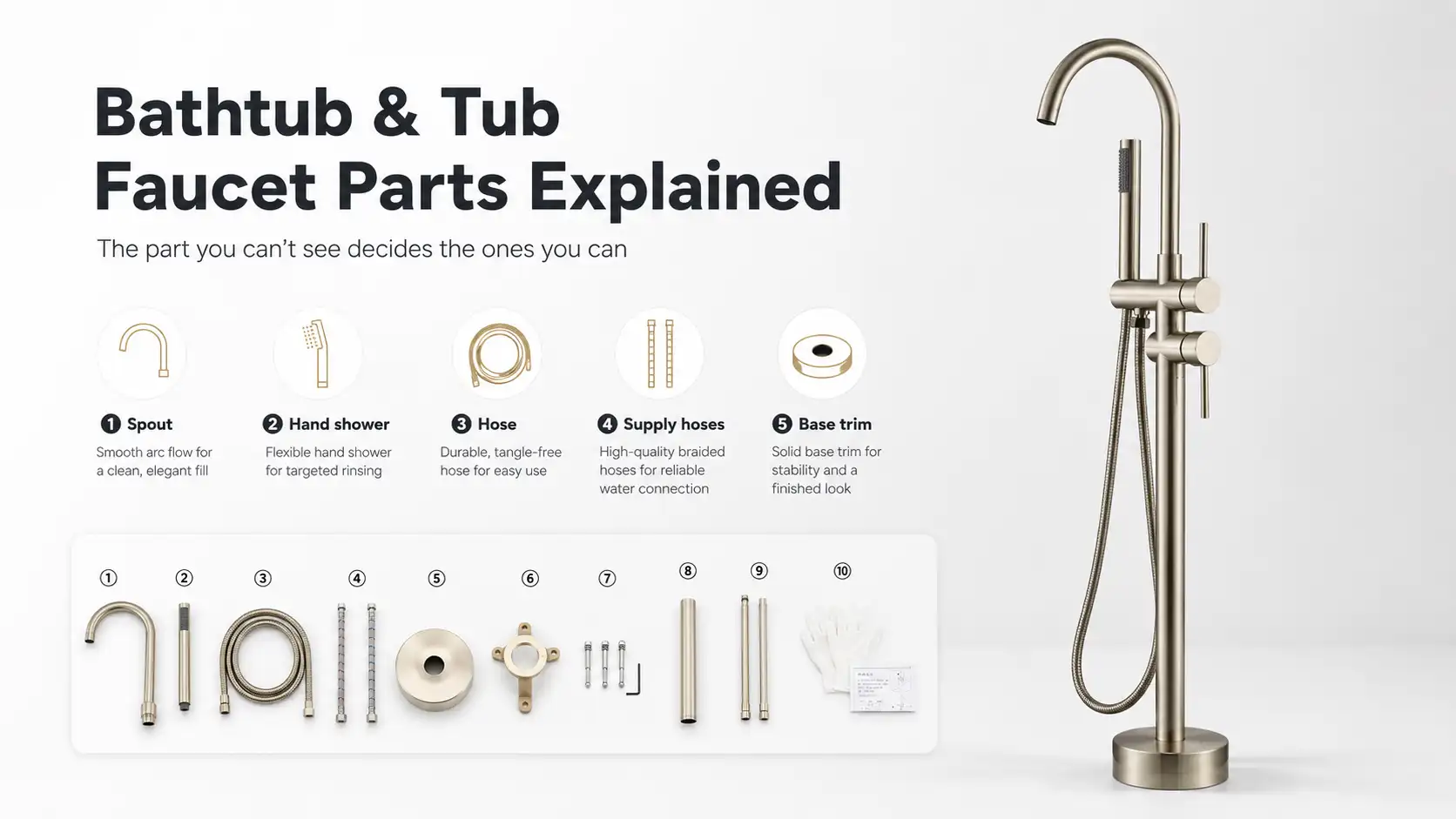
The visible parts are what a buyer points at in a catalog. Spout, handle, the plate that hides the hole, the hand shower on its hose. The hidden parts live behind the tile. There’s the valve body, plumbed into the hot and cold lines. And the cartridge inside it, which does the mixing.
That hidden group runs the fit. The single handle bathroom faucet carries the same lesson at the basin: the hole and the valve underneath decide the trim on top.
One more visible part earns a name — the trim plate, or escutcheon. It isn’t only decoration. It has to cover the hole cut in the wall for the valve. Swap a valve on a remodel and the new hole runs wider. The plate then has to be wide enough to hide it. A plate that’s too small leaves a gap around the valve.
In projects that use separate rough-in and trim packages the two stacks get bought apart. A rough-in valve goes in during construction. The trim gets picked later, sometimes years later, by someone who never saw the valve. That gap is where the wrong part gets ordered.
We don’t sell it that way. On our line the tub faucet ships as one matched set. Body, cartridge, spout, trim, and a hand shower on a 1.2-metre hose. The top stack and the bottom stack already fit each other. The one piece we don’t make is the standalone in-wall rough-in valve. When a project already has one and needs matching trim, we ask for a photo and we identify the valve and source the matching trim or quote a complete replacement set.
The valve decides the trim
Buying the parts loose is where people get burned. The trim is locked to the valve underneath. A plate, a handle, a cartridge — each is cut to a specific valve series, not to a category called “shower trim.” Toss the old trim, buy a plate you like, and the handle broach won’t line up with the valve in the wall.
A valve carries a series number. The trim built for that series fits it. Other trim doesn’t. The handle splines onto a stem of a set shape. The cartridge seats to a set depth. Change the series and those change with it. A “universal” trim claim only stretches so far. Some trim covers a range of one maker’s own valves. None of it reaches across makers. The broach and the stem still have to match.
A homeowner posts a photo of a bare valve and asks which trim fits. The answer comes back as a series number. That valve takes that series’ trim, and only that. Identify the valve first. Then the trim follows. Run it the other way and you’re mailing parts back.
Handle count doesn’t settle it either. One knob, two handles, three — the number is a look. It doesn’t set the valve type. A single-handle set can run a pressure-balance cartridge or a thermostatic one. The handle tells you nothing about which.
Because we ship the set, that identification step is ours to carry. The cartridge we build in is matched to the body it sits in. The cartridge guide covers how we hold that pairing steady. For a buyer replacing trim on a wall valve we didn’t supply, the rule still stands: photo of the valve first, part second. The photo that helps shows the valve face with the cartridge out, plus any number stamped on the body. That’s what a supplier reads to name the series.
What that hidden valve is required to do
The valve isn’t only a mixer. On a tub-shower it’s a safety device, and the code names it as one. Model plumbing codes — IPC and UPC — require the valve on a tub-shower combination to be pressure-balancing, thermostatic, or both. It has to be tested to ASSE 1016 / ASME A112.1016 / CSA B125.16. And it has to carry a stop that limits the outlet to 120°F. A plain two-handle mixer that only blends hot and cold doesn’t clear that on its own.
Both mechanisms are anti-scald. They work differently. A pressure-balancing valve — Type P — holds the hot-to-cold ratio when someone flushes a toilet and the cold pressure drops. A thermostatic valve — Type T — reads the mixed temperature and holds it. It answers to pressure and temperature both. We build both. Our thermostatic sets run a comfort band of roughly 35 to 42°C. The code limit stop caps the top end. Where a building’s hot supply swings — a recirculating line, a tankless heater cycling on and off — a pressure-balance valve holds the ratio but not the temperature. A thermostatic valve holds the temperature through it. That gap is the reason to spec one over the other.
That limit stop isn’t automatic. The installer sets it, and it can drift, so it gets checked. Older two-handle valves from before these rules don’t compensate at all. On a remodel they get replaced rather than rebuilt.
A plain tub filler is a different case. Spout only, no shower. Its anti-scald device follows ASSE 1070, and the filler doesn’t carry the shower valve’s job. We make those too.
I can’t call which type suits a given building from the factory. That rides on the hot-water system behind the wall. Whether the supply pressure and temperature hold steady is the thing we never get to see.
One note on certification. Some of our sets carry the ASSE 1016 listing and some don’t. It runs by SKU. The honest answer is to have us confirm the specific model, rather than read “certified” as a line across the whole range.
The spout is a connection
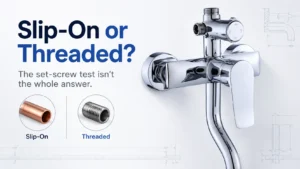
A tub spout looks like trim. Underneath it’s a connection. It meets the pipe one of two ways. Slip-fit: the spout slides over a 1/2-inch copper stub-out and locks with a set screw beneath. Threaded: it screws onto a 1/2-inch IPS nipple. Get the type wrong and it won’t seat, or it won’t seal.
What decides it isn’t the finish. It’s the stub-out. How far the pipe stands out of the wall, and whether it’s bare copper or threaded. A spout cut for a short stub won’t reach a long one. A slip spout won’t grip a threaded nipple. Reach matters too: the spout has to clear the tub rim so water falls inside the tub instead of down the edge. We make both types. Spout length is its own line — a longer body clears a thicker tub wall or a tiled apron. We ask for the stub-out length, the reach, and the pipe type before the spout ships.
A spout can also hold the diverter, which adds a pull-up rod on top. So a spout is sometimes a plain outlet and sometimes the diverter’s home. Which one it is changes the part.
Where the diverter actually lives
Water pours out the tub spout when it should climb to the shower. The first move is to buy a spout diverter kit. Sometimes that’s the part. Many times it isn’t the spout at all. The diverter that sends water up doesn’t always live in the spout. It can sit in the spout as a pull-up. It can sit in the valve as a rotating three-way. It can sit up in the hand-shower holder. On a set with a tub spout, a showerhead, and a hand shower, it sits in the valve as a three-way, because it picks between three outlets.
Three places, and each fails its own way. A spout diverter wears at a seal, and you replace the seal. The valve diverter is a cartridge inside the body. The holder has its own little valve. Each is a different part to order. We make all three. Naming which one is in the set is a line on the order, because a photo of the outside never shows it.
Mount type sets the water path
Wall, deck, freestanding — these read like style words. They’re plumbing paths. A wall-mount tub faucet takes its water through elbows in the wall. A deck-mount, or Roman, sits on the tub rim and drops shanks through pre-drilled holes. A freestanding filler stands on the floor and draws water up through it.
Each one changes what belongs in the box. The shanks. The mounting hardware. The supply connections. The hand-shower hose. A deck-mount needs the hole count and the centre distance named up front: a single-hole filler and a three-hole 8-inch spread are different parts. A freestanding filler needs the floor supply connection and the height, because the water comes up from below. A wall-mount needs the elbow spacing set into the wall. A freestanding filler also puts the supply lines on show. They run up the floor legs in the open, so the finish on those lines is on display rather than tucked behind tile.
The hand shower rides along with the mount. On a wall set it clips to a bracket. On a deck or freestanding set it drops into a holder on the deck or the filler body. The 1.2-metre hose has to reach from there to the tub without pulling tight. We build all three mounts, and the range sits under bathtub faucets. Send the tub layout — pre-drilled holes or not, where the supply comes up — and the mount follows from it.
Factory boundary for the tub faucet set
We make the tub faucet. Body, cartridge, spout, handle, trim, the hand shower and its hose. In the mount and diverter you name, marked on the SKU. We build the pressure-balance or thermostatic cartridge into the body and match the trim to it. We don’t make the standalone in-wall rough-in valve — send a photo and we source it for you. We don’t ship the drain and overflow as part of the faucet. That’s tub hardware on its own line, available on separate order. We don’t set the stub-out length or pick the valve type for your wall. Name the layout and the market, and the parts follow. Bodies come in brass, stainless, or zinc by SKU. Polished chrome is standard, other finishes on request. The stainless vs brass guide covers the material side, and the team can review a set against a specific tub at contact.
FAQ
What parts make up a tub faucet?
Bathtub faucet parts fall into two groups. The visible ones — spout, handle, trim plate, hand shower. And the hidden ones in the wall, the valve body and its cartridge. The hidden group decides what the visible group can be.
Can I put any trim kit on my existing valve?
No. Trim is cut to a specific valve series. Identify the valve first, then match the trim to it.
Are pressure-balance and thermostatic the same thing?
Both are anti-scald, but they work differently. Pressure-balance (Type P) holds the hot-cold ratio when supply pressure drops. Thermostatic (Type T) senses and holds the mixed temperature. Codes take either on a tub-shower valve, with a 120°F limit stop set at install.
Can I just buy the same tub spout and swap it on?
Only once you know the connection. Check whether the stub-out is 1/2-inch copper for slip-fit or 1/2-inch IPS threaded. Measure how far it stands out. The wrong type won’t seal.
Water runs out the tub spout instead of the showerhead — is the spout broken?
Maybe, but not always. The diverter that lifts water to the shower can live in the spout, in the valve, or in the hand-shower holder. If it’s in the valve, a new spout won’t fix it. A spout with a pull-up diverter, a three-way valve cartridge, and a holder diverter are three different parts. Find where yours sits before you order one.
Sources
- ASSE International — Product Performance Standards
Referenced for ASSE 1016 / ASME A112.1016 / CSA B125.16 scope covering automatic compensating valves for individual showers and tub/shower combinations, and ASSE 1070 / ASME A112.1070 / CSA B125.70 scope covering water-temperature-limiting devices used with bathtubs and other fixtures. - ASME — A112.18.1/CSA B125.1 Plumbing Supply Fittings
Referenced for the North American plumbing-supply-fitting standard covering bath and shower supply fittings, valves, tub spouts, hand showers and related components. - International Code Council — 2024 International Plumbing Code, Chapter 4
Referenced for model-code requirements covering fixtures, faucets, fixture fittings and tub/shower valve installations. Local adoption, edition and amendments must still be confirmed for the project jurisdiction. - IAPMO — Uniform Plumbing Code
Referenced as the second North American model-code path discussed in the article. The applicable adopted edition and local amendments must be checked before assigning a valve requirement to a project. - ASSE International — Certified Product Search
Referenced for model- and manufacturer-level verification of ASSE product listings rather than treating certification as a catalog-wide claim. - IAPMO R&T — Plumbing Certification for the USA and Canada
Referenced for North American plumbing-product evaluation and certification context, including verification against the standards applicable to the specific product and SKU. - HWFaucet — Single Handle Bathroom Faucet Guide
Internal reference for the relationship between the visible faucet, mounting hole, valve, deck plate and other installation specifications. - HWFaucet — Single Handle Faucet Cartridge Guide
Internal reference for cartridge-to-body matching, cartridge dimensions and replacement-part planning. - HWFaucet — Stainless Steel vs Brass Faucet Guide
Internal reference for body material, wetted-surface and certificate-scope questions that remain separate from valve and trim compatibility. - HWFaucet — Bathtub Faucet Range
Internal product reference for wall-mount, deck-mount and freestanding bathtub faucet configurations. - HWFaucet internal production and specification notes. Referenced for matched valve-body and cartridge sets, pressure-balance and thermostatic configurations, 35–42°C thermostatic comfort range, 1.2-metre hand-shower hose, slip-fit and threaded tub-spout options, diverter locations, mount-specific packing contents, material options, finish options and SKU-level certification boundaries.