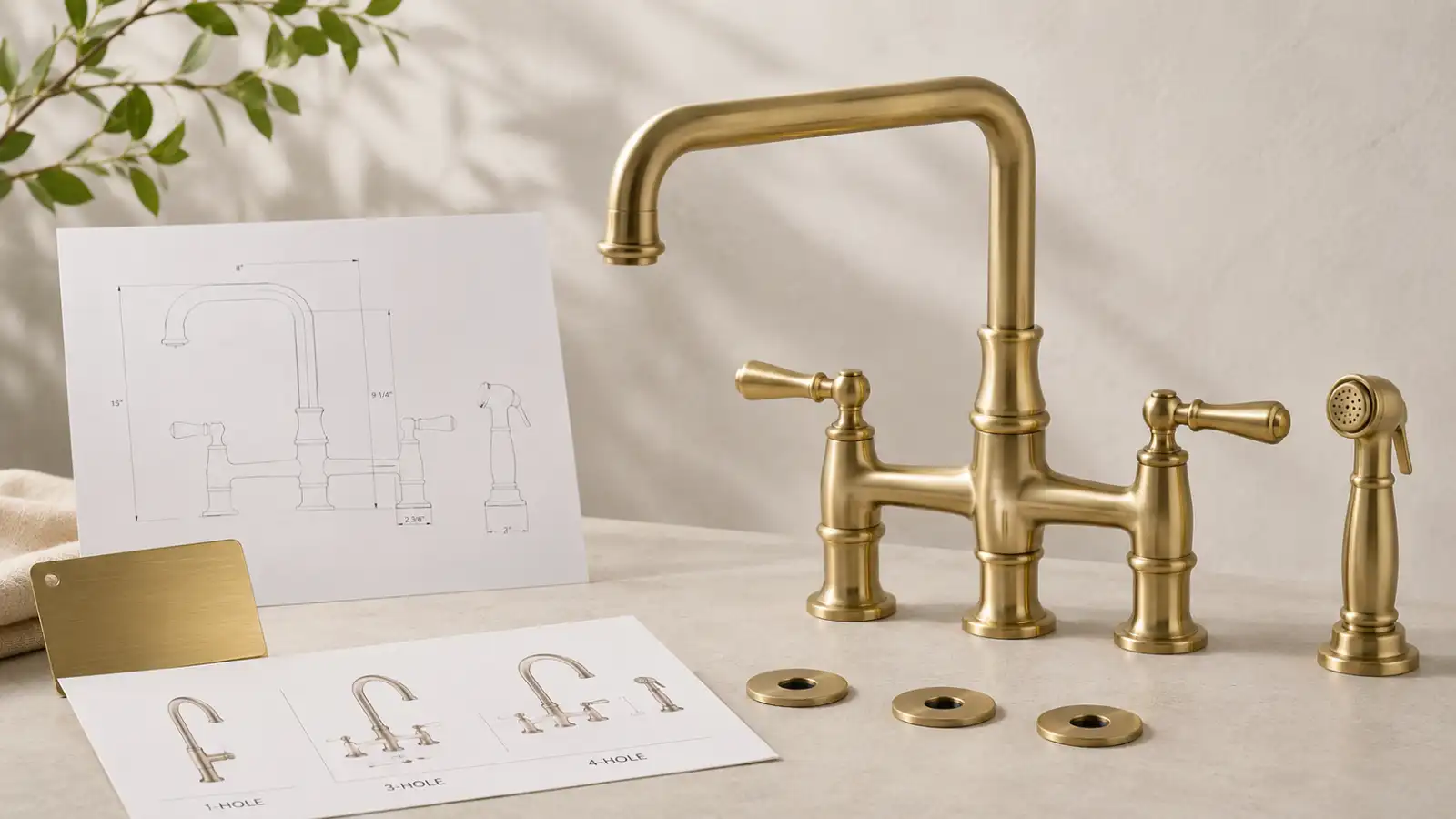
| Item | Standard bridge | Bridge + side sprayer | Pull-down bridge |
|---|---|---|---|
| Deck holes | 3 | 4 | 3 |
| Sprayer | none | separate pull-out side sprayer | pull-down from the spout |
| Availability | stock | stock | custom body and neck |
| Build change | — | one more hole | thicker body and neck, new molds |
| Pin on the spec | holes, handle, finish | + sprayer hole, hose | + arc height, retraction, molds |
The finish name is a look, not a behavior
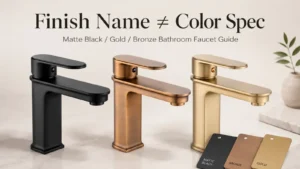
“Antique brass” tells you a target color. It says nothing about whether that color holds or moves. A sealed aged or antique finish is made to hold a specified color target, with normal batch variation. PVD brass-look seals the color and stays put. Unlacquered is raw brass left to move — it tarnishes and forms a patina on its own, darkening unevenly as it ages. A buyer who writes only “antique brass” has picked a shade and left the behavior blank.
We run polished, brushed, and PVD brass-look on our own line. Aged finishes and lacquer we send to a finishing shop that specializes in them. Unlacquered we don’t run at all — the bare surface tarnishes and shifts color on its own, and the questions come back months later, so we leave it off our sheet. A buyer who wants the old look should spec a sealed aged or PVD finish against a sample.
How a chemically aged finish looks after a few years in a real kitchen, I won’t promise from here. That step runs at a finishing shop, not on our floor.
Matching gets settled with a physical sample. We send a color card, then a pre-production sample for sign-off. We tell the buyer up front that batch color carries a small variation. Two suppliers can both say “antique brass” and ship two different colors.
The bridge body is the part that says no
A standard bridge faucet comes three-hole. Add a sprayer and the bridge takes a fourth hole for a separate pull-out side sprayer, off to one side. A pull-down, run down through the spout the way a modern kitchen faucet does, is the hard one on a bridge.
At a trade show in 2023 a European buyer came to us with a hard spec. He wanted a bridge with a taller, deeper arc — 520 mm, against the 300 to 400 mm our bridges normally run. No side sprayer. A pull-down off the spout, the way an ordinary kitchen faucet works, on the same three-hole deck. To get there we cut new molds for the body and the neck, and ran both thicker than a standard bridge so the structure could carry the reach. The retraction is the same gravity ball we use on a normal kitchen line. He funded the tooling; we took on 30 percent of it to show we meant it.
For a buyer that means a clean choice. Take the separate side sprayer and stay on stock tooling. Or fund the molds for a true pull-down bridge, and build the body to carry it.
What to pin, and what we are
We are a faucet manufacturer that reads the specs importers and distributors send over. We don’t sell DIY retail, and we don’t decide a market’s plumbing code. Threads go out to suit the market, NPT or G/BSP. Handles come as cross or lever to match the design, and they don’t carry across models, so a handle gets specified per faucet.
The waterway and the lead-free question sit in our guide on brass, stainless and zinc faucet materials — solid brass alone doesn’t settle drinking-water safety. The hose and retraction behind a pull-down bridge run the same way they do on any pull-down kitchen faucet.
Our kitchen faucet range carries the bridge bodies and the sprayer options. The team that reviews a bridge spec is on the contact page.
FAQ
What is the difference between an antique brass and an unlacquered brass kitchen faucet?
Antique brass is a finish made to look aged and then hold a set color. Unlacquered brass is raw and keeps changing — it tarnishes and forms a patina on its own. We ship the sealed finishes; unlacquered we don’t run, since the bare surface shifts color and brings questions later.
Will an antique brass kitchen faucet change color over time?
Depends on the finish. A sealed aged or PVD finish holds its color; a raw unlacquered one moves on purpose. Spec which one you want, and confirm it on a sample.
Can a bridge faucet have a pull-down sprayer?
Yes, but it is custom. A stock bridge takes a separate side sprayer in a fourth hole. A true pull-down stays three-hole but needs new molds and a thicker body to carry the reach. Budget for tooling, or take the side sprayer.
Is a vintage brass kitchen faucet safe for drinking water?
Solid brass alone doesn’t answer that. The lead-free rule lands on the wetted surface, which we cover in the materials guide linked above.
Do antique brass faucets need to match cabinet hardware exactly?
Use a physical sample to match, since the finish name alone won’t guarantee it. We send a color card and a pre-production sample, and batch color carries a small variation. Two “antique brass” parts from different suppliers can land on different colors.
Sources
- Better Homes & Gardens — Brass finish types Referenced for polished, brushed, antique, oil-rubbed and unlacquered brass finish types and how each behaves.
- Better Homes & Gardens — Unlacquered brass Referenced for unlacquered brass oxidizing and developing an uneven patina over time.
- U.S. Environmental Protection Agency — Use of Lead Free Pipes, Fittings, Fixtures, Solder, and Flux for Drinking Water Safe Drinking Water Act, Section 1417: lead-free defined as a weighted average of 0.25% lead across wetted surfaces.