| Where it’s installed | Flow ceiling | Set by |
|---|---|---|
| Public restroom — office, school, airport, mall | 0.5 gpm at 60 psi | ASME A112.18.1 / CSA B125.1, IPC / UPC |
| Metering / self-closing, public | 0.25 gallon per cycle | same |
| Private — home, hotel guest room, private hospital room | 2.2 gpm federal; 1.5 with WaterSense; 1.2 in CA / HI / OR / WA | 10 CFR 430.32, EPA, state rules |
A single handle lavatory faucet can land in any of those rows. Which row is a purchasing decision. It gets made, or missed, on the PO.
“Lavatory” and “commercial” point at two different things
“Lavatory faucet” is trade wording for a bathroom sink faucet. Nothing more. The residential single-handle version is a separate article — hole count, deck plate, drain kit. The single handle bathroom faucet guide walks through it. Here the load-bearing word is “commercial.” In the plumbing codes it isn’t a build grade. It maps to public use. A commercial bathroom sink faucet is a public-use lavatory faucet — same body, tighter spec.
The public/private split isn’t about whether the building is commercial. EPA’s definitions put the private label on homes, hotel and motel guest rooms, senior-care units, and private hospital rooms. The public label goes on non-residential spaces open to walk-in traffic: offices, schools, transit, assembly halls. A hotel is both at once. Guest-room faucet: private. Lobby restroom: public. The staff washroom used by one attendant: private again.
Importers get this wrong in one specific way. They order to the building type. The room is what sets the flow class. A boutique hotel job comes in tagged “commercial.” The whole fixture package gets quoted at one flow class. Then the lobby restroom fails inspection, because it needed 0.5 gpm and arrived at 1.5. Ask which restroom it is before asking which building — that sorts the flow class before anything gets quoted.
The flow ceiling hiding inside the word
For a public lavatory the code ceiling is 0.5 gpm at 60 psi. Metering faucets — push it, it runs for a set time — cap at a quarter gallon per cycle. Private lavatories are looser. The federal number is 2.2 gpm. A WaterSense label means 1.5. California, Hawaii, Oregon and Washington already require 1.2. EPA released a draft Version 2.0 proposing 1.2 gpm for private lavatory faucets. EPA’s page says that revision work was paused in February 2025, so the current WaterSense label still sits at 1.5 gpm. The split follows traffic. A public lavatory handles quick handwashing across a crowd, so the code trims it hard. A private one fills a basin and runs a shave, and keeps more flow.
Metering is a third path. Push the handle and the valve runs for a set time, then shuts. It changes what the user expects. The water stops on its own, and someone used to a running tap can read that as a fault.
One point here trips up a spec sheet. A faucet can carry a WaterSense label and still be wrong for a public restroom. WaterSense certifies to 1.5 gpm. A public lavatory needs 0.5. The label reads like a green flag. For that room, it doesn’t hold.
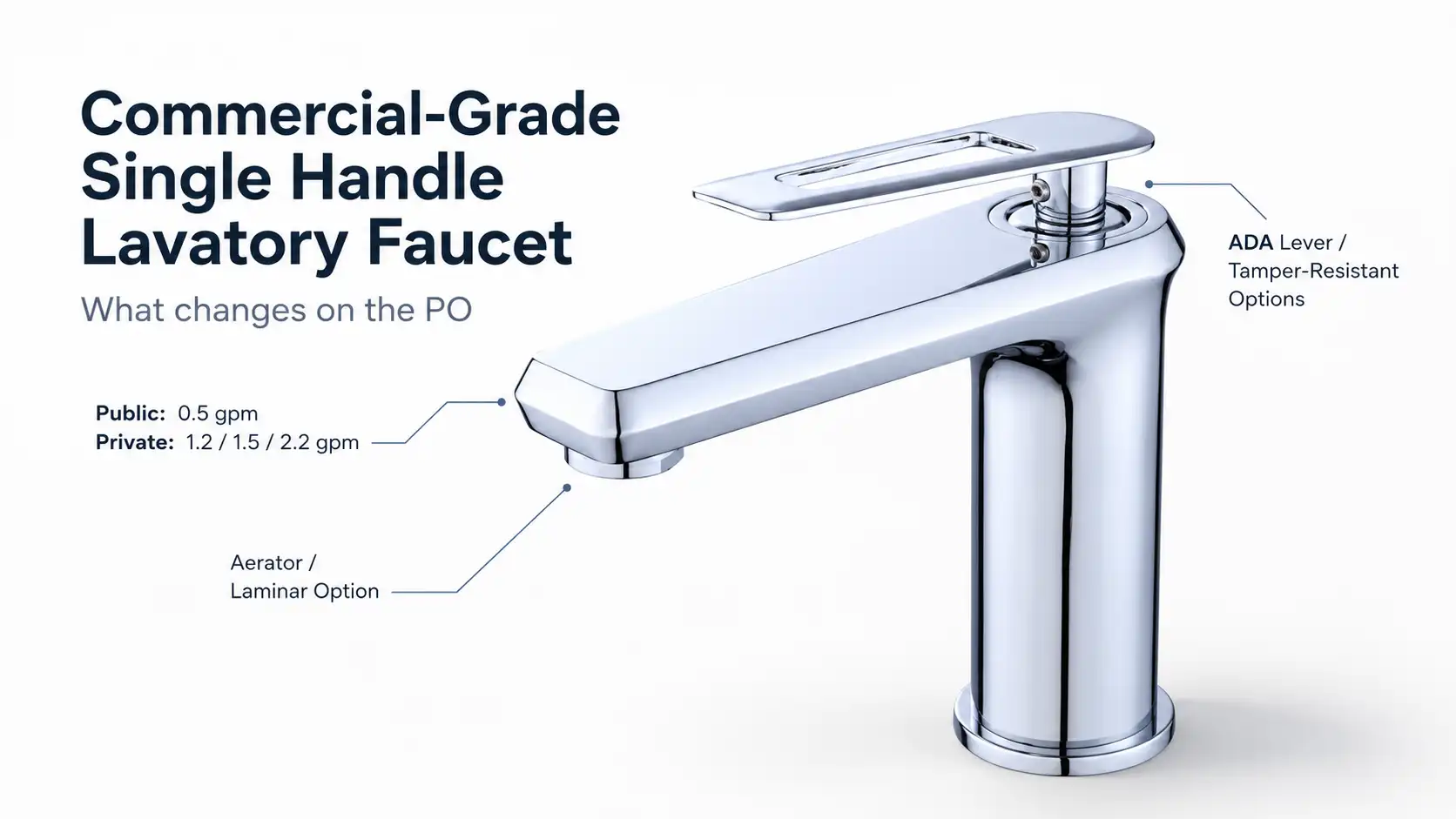
On our line, flow isn’t a property of the faucet body. It comes from the insert — the aerator or flow cartridge that screws into the spout. We stock 8.3, 5.7, 4.5 and 1.9 L/min inserts. That’s 2.2, 1.5, 1.2 and 0.5 gpm, in both pressure-compensating and fixed-orifice versions. A fixed-orifice insert holds its rating at one pressure. A pressure-compensating one holds the flow across a range, which matters in a tower where pressure swings floor to floor. The insert is fitted at the factory. It isn’t meant for the end user to swap, so a public-use order ships with the 1.9 L/min piece already in.
That detail — flow rides on the insert rather than the casting — closed a Korean job for us in 2023. A customer reached us on WeChat for a multi-hotel renovation. The spec called for 4.5 L/min. Our KC certificate covered the 5.7 L/min build. Re-running KC on a fresh configuration costs real money and weeks. We didn’t do that. We fitted a 4.5 L/min cartridge that already held its own KC listing. The certificate followed the cartridge, and the faucet body never had to be re-listed. Swapping the cartridge on the line took days; a new KC submission would have run weeks. The customer took it.
The same logic holds for other market marks. When the flow insert carries its own listing, a flow change doesn’t force a fresh certificate on the whole faucet. So flow class and certificate both sit on the SKU, under the model name. A public build and a private build can wear the same catalog photo and need different paperwork.
When a job mixes public and private restrooms, we split them into separate SKUs at the quote stage. One flow class doesn’t get to ride the whole order.
Why it feels weak after install
The complaint after install is familiar. “The water’s weak, the faucet must be defective.” Most of the time it isn’t the faucet. A public lavatory at 0.5 gpm is doing what the code told it to do.
Part of it is the flow class. Part is the insert type — an aerator reads softer and fuller than a plain stream at the same gallons. The rest is the building’s supply pressure, which we never see. WaterSense holds a floor of 0.8 gpm at 20 psi, so a private faucet still performs where pressure is low. We test flow at 60 psi on the bench. The bench is a reference point; the jobsite runs on its own pressure.
Then the friction that costs money. A facility collects “weak flow” complaints. Someone on maintenance pulls the flow control, or drops in a higher-flow aerator. The water savings the project was specced for are gone. If the building claimed a water-efficiency credit, that quiet swap breaks it. The splash and the floor puddle come back too. The restrictor did what it was rated to do; the mismatch was pressure or expectation. By then the fixtures are in. Fixing flow means pulling inserts across a floor or re-ordering, and that rework lands after the invoice is paid.
I can’t tell you which flow class will feel right in a given building. That rides on the supply pressure behind the wall, and it’s the one variable we never measure from the factory.
Commercial-grade doesn’t have to mean a sensor — and it doesn’t mean a longer warranty
Plenty of buyers hear “commercial restroom” and jump to touchless. Sensor faucets fill public washrooms, so the assumption is that commercial-grade means electronic. It’s a category error. Manual single-handle commercial faucets are their own class, and the commercial-grade part lives in the hardware rather than a battery.
On our line that hardware is a vandal-resistant handle with a hidden hex set screw. A tamper-resistant aerator that needs a key to remove. An ADA lever option. In a public restroom, the aerator gets unscrewed or walks off. The tamper version needs a key to remove. It sits on the commercial line for that reason. Lavatory controls fall under ADA §606.4, which points to §309.4. The cap is 5 pounds of force to work the control. No tight grip, no wrist twist — a lever you can run with a closed fist. Hitting that 5-pound limit leans on the cartridge, since a smooth ceramic disc keeps the handle light enough to pass. We stock 25, 35 and 40 mm ceramic cartridges. The 48-hour open-close cycle test and batch report from the single-handle kitchen line carry over here.
We make sensor lavatory faucets. We do not make metering or self-closing valves. Where a jurisdiction requires self-closing faucets in a public restroom — some do — that’s a build we don’t supply. ADA also sets the run time on those: the valve has to keep water flowing at least 10 seconds so a user can actually wash. That timing is a metering-valve spec, and metering valves aren’t on our line. The importer confirms the local rule before the order goes out.
The warranty runs backwards from what buyers expect. The commercial-grade version carries the shorter guarantee of the two. On our line the commercial lavatory faucet carries 2 years; the residential version carries 5. Commercial-grade buys tolerance for abuse and traffic — schools, transit, revolving-door use — rather than a longer paper promise. The real question for year five is whether a replacement cartridge is still on the shelf. We don’t bundle spares. Cartridges come as a separate purchase line, and a common 35 mm size is easier to source years out than an odd one. An importer who skips that spare line hears about it around year three, when a cartridge fails and the size has been discontinued.
When an aerator is the wrong outlet
An aerator pulls air into the stream. It feels soft that way, and it doesn’t splash. It’s the default on nearly every bathroom faucet. In a healthcare or high-sanitation setting, it’s the wrong choice. The air path and the wet screen give waterborne bacteria a place to sit. CDC names Pseudomonas and Legionella among the water pathogens most tied to healthcare-associated infection. They spread partly through the aerosol a tap throws. CDC points to aerators and showerheads as reservoirs worth removing and cleaning where cases show up.
The design answer in those buildings is a laminar flow insert. Same soft, clear stream. No air drawn in. A laminar insert threads into the same spout an aerator does, so swapping one for the other leaves the faucet body and the rough-in alone. We can supply laminar inserts in place of aerators on this line. What we don’t do is run hospital field trials or claim first-hand infection-control data. The sanitation reasoning comes from facility guidance. The part we speak to is the outlet we ship.
One note for the sensor crowd: electronic-eye faucets have themselves been logged as Legionella and Pseudomonas reservoirs in hospitals. “Go touchless for hygiene” isn’t automatic in the one place hygiene is the whole point.
The lines this puts on the PO
These become rows on a purchase order, and the skipped rows surface at packaging or on the jobsite. Flow class by SKU, tied to the target market. Outlet type — aerator, laminar, tamper-resistant or not. Handle — standard, vandal-resistant, or ADA lever. Handle marking too — H/C, red and blue, or a market’s own symbols — since a fitter who ignores it can cross the supply tails. Inlet thread, NPT or BSP, with the ISO 7-1 / 228-1 forms behind them, confirmed per market. Certificate scope written against the SKU rather than the catalog. Wetted surface and lead-free ride there too; the stainless steel vs brass guide covers that side. For North American jobs, that certificate line also includes the plumbing listing — a cUPC or IAPMO mark. The local authority checks it before the fixture is legal to install. Cartridge size, plus a spare line if the buyer wants year-five coverage. Drain — its own order line; the standard box doesn’t include it.
Our standard build is polished chrome, ceramic cartridge, body in brass, 304 or 201 stainless, or zinc by SKU. Other finishes on request. On a single handle lavatory faucet, the vandal-resistant handle, tamper aerator, ADA lever and laminar insert are options a buyer names on the order.
What we do and don’t decide
We build the single handle lavatory faucet to the flow class and outlet named on the order. We mark both on the SKU. We don’t sign off on a building’s supply pressure. We don’t decide whether a restroom counts as public or private for a jurisdiction. We don’t ship a drain that wasn’t quoted. Name the market and the room, and the spec follows. The current lavatory range sits under basin faucets, and the team can review a build against a specific project.
FAQ
Is a commercial-grade lavatory faucet just a heavier residential one?
No. The commercial-grade part is the vandal-resistant hardware, the ADA lever, and tolerance for high-traffic abuse. On our line it also carries a shorter warranty — 2 years against 5 for residential.
The office restroom faucet barely trickles. Is it broken?
Probably not. A public lavatory is capped at 0.5 gpm by code. At that flow, a fine faucet still reads weak.
Does a commercial restroom have to use a sensor faucet?
No. Manual single-handle commercial faucets are a full category. Some jurisdictions even require manual self-closing valves — a build we don’t make.
Can a WaterSense faucet go in a public restroom?
A WaterSense label certifies to 1.5 gpm, which suits a private lavatory. Public lavatories need 0.5, so the label alone doesn’t clear a public restroom. The flow class on the SKU does.
For a clinic or hospital sink, aerator or laminar?
Laminar, in most patient-care and high-sanitation areas. An aerator draws air across a wet screen. That air path, plus the aerosol at the spout, is what healthcare guidance treats as a bacterial risk — Legionella and Pseudomonas. A laminar insert gives the same soft stream without pulling air in. We can supply the laminar version on this line. Whether a given room needs it is a call the facility’s water-management plan makes.
Sources
- U.S. DOE FEMP — Best Management Practice #7: Faucets and Showerheads Referenced for the plumbing-code flow limits of 0.5 gpm for public lavatory faucets and 0.25 gallon per cycle for metering faucets, and for the 2.2 gpm federal maximum.
- ASME A112.18.1 / CSA B125.1 — Plumbing Supply Fittings Product standard referenced for the maximum flow rate of public lavatory faucets (0.5 gpm at 60 psi), metering faucet limits (0.25 gallon per cycle), and the test procedures used to measure faucet flow rate.
- U.S. EPA WaterSense — Bathroom Faucets Referenced for private lavatory faucet labeling scope, EPA’s public/private lavatory distinction, public lavatory 0.5 gpm guidance, and EPA’s paused draft Version 2.0 revision note.
- U.S. EPA WaterSense — High-Efficiency Lavatory Faucet Specification Referenced for WaterSense private-use scope, exclusion of metering and public-use lavatory faucets, 1.5 gpm maximum at 60 psi, 0.8 gpm minimum at 20 psi, and ASME A112.18.1 / CSA B125.1 testing reference.
- eCFR — 10 CFR 430.32 Energy and Water Conservation Standards Referenced for U.S. federal maximum water use for lavatory faucets, lavatory replacement aerators, kitchen faucets and metering faucets at 60 psi.
- U.S. Access Board — ADA Chapter 6, §606 Lavatories and Sinks Referenced for ADA faucet-control linkage to §309 and the minimum 10-second opening requirement for hand-operated metering faucets.
- U.S. Access Board — ADA Chapter 3, §309 Operable Parts Referenced for one-hand operation, no tight grasping, no pinching or wrist twisting, and 5-pound maximum activation force for operable parts.
- CDC — Considerations for Reducing Risk: Water in Healthcare Facilities Referenced for healthcare water-management framing, sink and drain splash risk, OPPP exposure, sink design choices, and named premise-plumbing pathogens including Pseudomonas aeruginosa and Legionella pneumophila.
- NSF — NSF/ANSI/CAN 61 Drinking Water System Components: Health Effects Referenced for drinking-water-contact component health-effects certification language used when discussing wetted surfaces and faucet compliance scope.
- NSF — NSF/ANSI 372 Drinking Water System Components: Lead Content Referenced for lead-content certification language used in North American faucet compliance discussions.
- IAPMO R&T — Plumbing Certification USA and Canada Referenced for North American plumbing product certification context and evaluation against applicable plumbing standards.
- HWFaucet — Single Handle Bathroom Faucet Guide Internal reference for residential single-handle bathroom faucet questions around hole count, deck plate, drain kit, spout reach, cartridge and market thread.
- HWFaucet — Stainless Steel vs Brass Kitchen Faucet Guide Internal reference for wetted surface, lead-free scope, certificate range and faucet material decisions.
- HWFaucet — Basin Faucet Range Internal product reference for lavatory and basin faucet project scoping.
- HWFaucet internal production notes. Referenced for flow insert stock in 8.3, 5.7, 4.5 and 1.9 L/min, pressure-compensating and fixed-orifice options, factory-fitted insert practice, Korean hotel renovation inquiry, cartridge sizes, 48-hour open-close cycle test, warranty split, drain-kit quotation boundary, and commercial-line hardware options.