“Is it 1/4 inch?” is the first thing buyers ask about an RO faucet. We say yes. The question is still open.
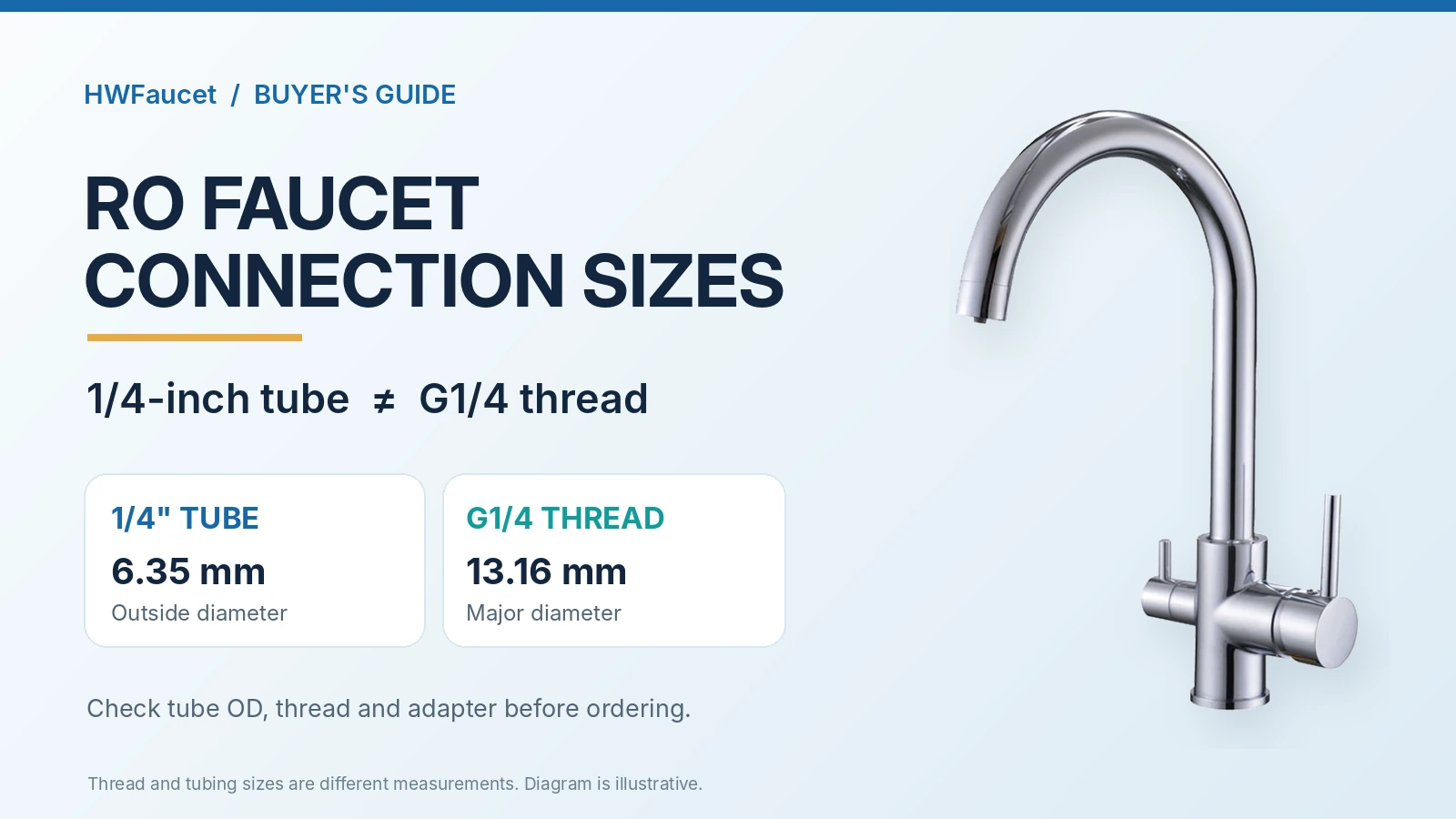
A 1/4-inch RO tube is 6.35 mm across the outside. A G1/4 thread under ISO 228-1 is 13.157 mm across the crest, at 19 threads per inch. Both get written as “1/4” on quotes, packing lists and product pages, and they describe different parts of the same connection.
This guide follows an RO and filtered water faucet spec the way it lands on a purchase order: thread, tube, deck, air gap, after-sales. It’s written for importers, distributors and project buyers.
Thread and Tube: Five Callouts That Get Written as Two
On our line, the purified-water inlet comes in three threads: 7/16-24 UNS, G1/4 and G3/8. The tube end ships at 1/4 inch by default. Adapters go in the carton when the buyer’s system needs something else.
| Callout | What it measures | Size | Standard |
|---|---|---|---|
| 1/4″ tube | Outside diameter of the poly tube | 6.35 mm | Inch tube OD |
| 3/8″ tube | Outside diameter of the poly tube | 9.525 mm | Inch tube OD |
| 7/16-24 UNS | Thread major diameter, 24 threads per inch | 11.11 mm | ASME B1.1 (unified special) |
| G1/4 | Parallel pipe thread, 19 threads per inch | 13.157 mm | ISO 228-1 |
| G3/8 | Parallel pipe thread, 19 threads per inch | 16.662 mm | ISO 228-1 |
A G1/4 nut won’t start on a 7/16-24 shank. The diameters sit about 2 mm apart and the pitches don’t match. A buyer who reads “1/4” as one thing ends up with a faucet and an RO unit that only meet through an adapter.
UNS is the ASME B1.1 designation for a unified-form thread whose diameter and pitch sit outside the standard coarse and fine series. Hardware store bins carry little of it. If the adapter isn’t in the carton, the installer can’t improvise one on site.
Here’s the order that taught us this.
In 2024, at a bath and kitchen show in Saudi Arabia, we met a buyer from Belgium. He wanted an SS304 faucet with a purified-water outlet. We went through the details at the booth, and after the show we sent him two samples. He tested them, liked the build, and was fine with the adapter.
Then the first 100 pieces reached his warehouse, and they wouldn’t connect to his customer’s tubing. Different outside diameter.
Nothing changed between the samples and the shipment. The difference was on his side: the setup he tested on wasn’t the one the project used. He was in a hurry, so we sent the adapters by air, free of charge, and he paid the freight. I’d have to go back through the emails to tell you what size that project tubing was.
Air freight on a small part, after the main shipment has landed, is the cost nobody budgets for. On a project order, the tube OD on the PO has to come from the installer’s RO unit. Neither the sample test rig nor the destination country settles it.
Two Outlets, One Hole: What a Dual-Outlet Faucet Changes on the Deck
Buyers ask for it as a “kitchen faucet with filtered water” or a “kitchen faucet with purified water.” On our line it’s one body with two spouts. One runs mixed hot and cold. The other runs RO water. Two handles, two cartridges: 35 mm for hot and cold, 25 mm for the purified side.
Three lines hang underneath: cold, hot and purified water. The hot and cold hoses are the same EPDM hoses that ship with our other kitchen faucets. RO waste never passes through this faucet. It runs from the RO unit to the drain on its own route.
Inside the body, the purified water runs through PEX tubing. We went that way for health reasons. RO water carries few minerals, and we’d rather it travel in its own tube than share the casting with the tap-water side. Our stainless steel vs brass kitchen faucet guide covers why low-mineral water changes the material question. For a part-by-part breakdown of body, waterway and handle, see the faucet materials guide.
The dual-outlet body mounts through the standard hole and hardware our single-hole kitchen faucets use. A thicker countertop reduces the mounting length available below the deck. The faucet’s maximum deck thickness and the available extension hardware have to be checked before the hole is drilled.
Hole size on dedicated RO taps has moved over the decades. A US patent filed in 1988 (US 4,856,121) describes earlier air gap faucets that needed an opening around 1-1/4 inch. That opening had to pass the mounting stud, the drinking-water line and two waste lines. The same patent then describes a mount that fits openings as small as 5/8 inch. Current models vary again, so the purchase number comes from the model drawing.
For a sink with one hole and stone you’d rather not drill, the dual-outlet faucet is the lower-risk spec.
The certificate needs a second look. Our dual-outlet range carries ASME A112.18.1/CSA B125.1, NSF/ANSI 61 and NSF/ANSI 372, and the listing covers the dual-outlet structure itself. NSF/ANSI 372 caps lead at a weighted average of 0.25% across every wetted surface. A two-outlet faucet has an extra waterway, so a certificate for a single-outlet body in the same finish doesn’t reach it. Ask for the SKU on the listing.
What the dual-outlet faucet leaves open is the air gap. We get asked whether going 3-way removes the need for one. It doesn’t. The air gap is a backflow safety part on the RO waste side, and that waste never touches this faucet.
Non-Air-Gap Faucet, Air Gap Still Required
Under the Uniform Plumbing Code, RO discharge enters the drain through an air gap or a listed air gap device (Section 611.2). The section names NSF/ANSI 58 and IAPMO PS 65 as device standards. California’s 2025 plumbing code carries the same section.
“Non-air-gap” on a faucet describes the faucet, not the installation. The gap has to live somewhere:
- in a standalone RO faucet, which then takes two waste connections and has a vent hole in the base;
- on the deck, as a separate air gap device;
- on the wall, above the RO unit;
- as an open gap above the rim of a receptor.
At least one state health department’s RO guidance goes further. When the waste line connects to the trap under the sink, the air gap has to sit above the sink rim. Under-sink check valves and “air gap adaptors” don’t count.
A 3-in-1 kitchen faucet carries no waste line. On that layout the gap always sits on a separate device or an open drain point. If the destination reads the rule the way that state guidance does, the second spout disappears. The deck or wall spot for the air gap device stays.
A faucet air gap has a test behind it. NSF/ANSI 58 submerges the air gap and pulls 85 kPa of vacuum on the outlet side. The same vacuum then goes on the inlet side for one minute, and no back-siphonage is allowed. For reject-water connections other than air-gap faucets, the standard asks for a vertical gap of two pipe diameters or 1 inch, whichever is larger.
Our early RO faucets were all non-air-gap. Air-gap models joined the range in 2024–2025.
We make the faucet. We don’t make air gap devices, drain saddles or RO units, and we don’t decide which rule a buyer’s market follows. The local authority does.
Take a standalone RO drinking faucet going into a UPC-based market, where nobody has specified a separate listed air gap device. There the air-gap version is the safer SKU. On a 3-in-1 kitchen faucet that choice moves off the faucet entirely. The PO has to name the device and who supplies it.
When the Air Gap Hole Leaks: What Comes Back to the Factory
Gravity is the only thing moving RO waste from the air gap to the drain. A clog, a kink or a flattened tube backs the water up and out of the vent hole on the deck.
Of the air-gap leak complaints our wholesale customers passed back to us in 2024–2025, around 90% traced to installation or the drain line. We file a case under installation when the waste tubing was kinked, crushed or routed wrong. It goes under drain when the waste line or the drain connection was blocked.
So the order we agree with a wholesaler starts under the sink. Clear the waste line, then check its routing. Only after that do we look at the faucet: the air gap channel for blockage first, then the sealing structure. Parts go out once the cause is found.
For the buyer, the useful step is agreeing that order with us before the first shipment. Without it, a field complaint becomes a faucet return by default. Cartridge spares are a separate decision; the single-handle kitchen faucet guide covers sizing and why spares matter years later.
The One-Line RO Faucet PO
RO faucet inquiries reach us as “I need RO kitchen faucet” or “kitchen faucet with purified water.” That’s the whole spec.
We send styles. Once the buyer picks one, we ask where it’s going and whether it’s wholesale or a project. Samples still go out sized to the destination country’s default tubing, because a lot of buyers don’t know their size at the sample stage. That default is a starting point. Before mass production, the project’s tube OD has to be on the PO, taken from the installer’s RO unit.
Before and after:
Before:
RO kitchen faucet, purified water, SS304, brushed, 100 pcs

After:
Dual-outlet kitchen faucet, SS304, brushed, 100 pcs
Purified inlet: G1/4 thread, adapter to project RO tube OD ___ (from installer's unit)
Hot/cold: EPDM hoses, destination-market thread
Air gap: separate listed device, supplied by ___
Deck: standard hole, max deck thickness ___, extension hardware Y/N
Certificates: ASME A112.18.1/CSA B125.1, NSF/ANSI 61, NSF/ANSI 372, listing names this SKU
After-sales: diagnosis order agreed (waste line → routing → air gap channel → seals)
The Belgian order was missing the second line.
The full range is in our kitchen faucet collection. Send us the RO unit’s tube spec before mass production starts.
FAQ
Is G1/4 the same as 1/4-inch RO tubing?
No. G1/4 is a 13.157 mm thread; 1/4-inch tubing is 6.35 mm across.
What size hole does an RO faucet need?
Our dual-outlet faucet uses the standard single-hole kitchen opening. Check the maximum deck thickness too. For a dedicated RO tap, take the number from that model’s drawing.
Does an RO faucet need an air gap?
The RO system does, under UPC-based codes. A standalone RO faucet can carry it. A 3-in-1 kitchen faucet can’t, so the gap goes on a separate device.
Can a 3-way kitchen faucet connect to an RO system?
Yes, if the purified side has its own waterway and the inlet matches the RO unit’s tube. On ours, the purified side has its own 25 mm cartridge and a PEX inner tube. The inlet comes in 7/16-24 UNS, G1/4 or G3/8, with a 1/4-inch tube end and adapters on request. Two checks remain after that. The certificate has to name the dual-outlet SKU. And the RO waste, which bypasses the faucet, still needs a listed air gap device or an open gap at the drain.
Is a “kitchen faucet with purified water” a 3-way faucet?
That’s what our buyers call it. Same faucet: hot, cold and RO water from one body.
Sources
- ISO 228-1 parallel pipe thread dimensions (G1/4 13.157 mm, G3/8 16.662 mm, 19 TPI) — Engineers Edge, BS EN ISO 228 table
- ASME B1.1 UNS designation — Eng-Tips, quoting ASME B1.1-2003 §6.1/6.4; 7/16-24 UNS size table — MFG Robots UNS thread table
- Uniform Plumbing Code §611.2 text (2018/2021) — WCP, “Inside the 2021 Uniform Plumbing Code,” Thomas Palkon (IAPMO)
- California Plumbing Code 2025 §611.2 — gocodebook CPC mirror
- IAPMO PS 65-2026, Airgap Units for Water Conditioning Equipment Installation (current edition) — IAPMO, Current PS Standards
- State health department RO guidance (air gap above sink rim; under-sink check valves not approved) — Minnesota Department of Health, Point-of-Use RO Installations; Minnesota Rules 4714.0611
- NSF/ANSI 58 air-gap faucet vacuum test and two-diameter / 1-inch requirement — WCP, “Requirements for air-gap faucets”
- NSF/ANSI 372 weighted average 0.25% lead across wetted surfaces — NSF, Safe Drinking Water Act requirements
- Faucets under ASME A112.18.1/CSA B125.1 plus NSF/ANSI 61 and 372 — WaterWorld / NSF, “Faucet Foundations”
- Earlier RO air gap faucets at ~1-1/4 inch; improved mount for openings down to 5/8 inch (filed 1988, issued 1989) — US Patent 4,856,121
- HWFaucet internal: thread options, default tube, adapters, dual-outlet structure, cartridges, PEX inner tube, certificates, 2024 order case, 2024–2025 wholesaler complaint records and classification, after-sales diagnosis order, inquiry wording and quoting sequence — HWFaucet sales and after-sales records