| One-minute field reading | What it screens for |
|---|---|
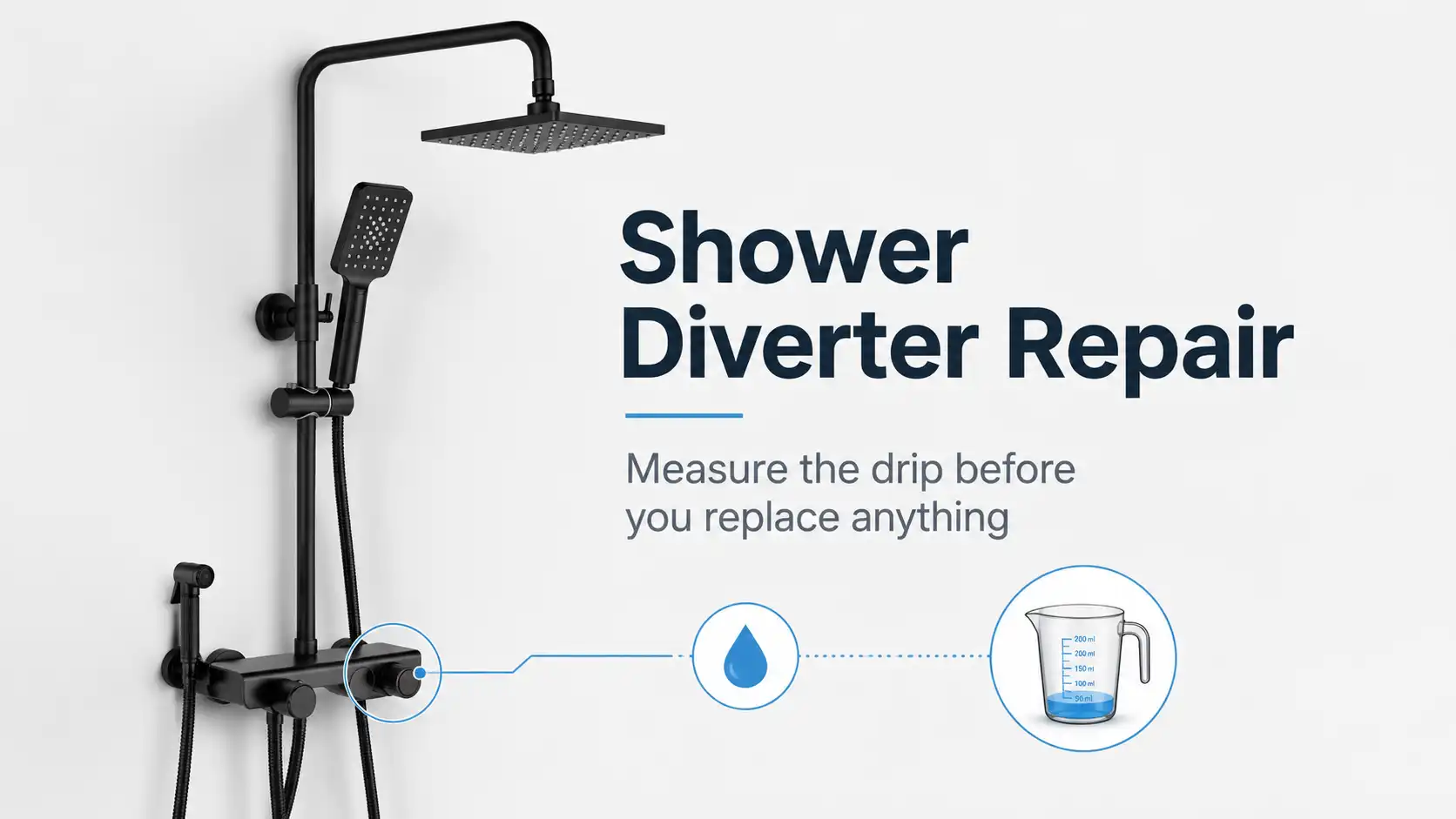
| Up to ~380 mL (0.1 gpm) | At or under the national pre-life-cycle figure |
| ~380–760 mL (0.1–0.2 gpm) | Over the pre-life-cycle figure; matches the post-life-cycle figure only after the prescribed cycle test |
| Over ~760 mL (0.2 gpm) | Over both national figures |
A 250 mL kitchen cup overflows in about forty seconds at the lower figure. The allowance is visible to the naked eye. Seeing water was never the test.
The cup screens. It doesn’t certify. Those national figures come from a laboratory at a set pressure and temperature. One of them applies only after a prescribed cycle test has been run. A field reading tells a dealer which conversation to have. It doesn’t tell anyone a unit is compliant.
Each band points somewhere different. A reading under the lower figure means no part needs to move. The answer to that complaint is an explanation rather than a shipment. Between the two figures, the unit is aging and heading one way. Ordering a seal now costs less than the second phone call. Past the upper figure, something failed or the installation needs looking at.
Sorting complaints this way stops a dealer from shipping replacements against units that are working as designed. It also catches the opposite error. A brand-new diverter reading 0.15 gpm has not met the pre-life-cycle figure, whatever the post-life-cycle number says. It gets inspected, corrected and retested before release.
The standard allows it to leak, and it says how much
ASME A112.18.1 / CSA B125.1 governs bath and shower diverters across North America. It sets a leak rate. It does not set a pass/fail on whether anything drips.
A new diverter is allowed up to 0.1 gpm out of the tub spout while water runs to the showerhead. After life cycle testing that allowance rises to 0.2 gpm. Two numbers, two different points in the product’s life.
EPA puts this in terms a buyer can picture. Across one typical shower, the first figure sends about half a gallon down the drain. The second sends a full gallon.
Almost nobody selling repair parts explains this. The retail answer to a dripping spout is a washer kit. Sometimes the washer is fine and the reading is inside the line.
Take the reading properly or don’t take it. Run the water at normal household pressure. Let it settle for a minute after switching to shower mode, since the first seconds always shed water. Then catch a full minute. A five-second glance and a guess is how a good batch gets rejected.
On our line the 0.1 gpm figure is the acceptance number. We pull 10% of a batch and run a 48-hour diverter switching test on that sample. Pass, and the batch ships. One failure inside the sample and the entire batch goes back through — not the failed piece, the batch.
That rule matters more than the number itself. A single leaker is a piece of bad luck. A leaker inside a 10% sample suggests the population behind it, and re-testing the batch is the only way to find out. We run a pressure test and a mechanical switching test alongside it, and the results go into a written report a buyer can request.
We don’t print the leak rate on the SKU or the cutsheet. It lives in the report.
California is not a rounding variation on the national figures. Its own regulations set tub spout diverter leakage at 0.01 gpm when new. After 15,000 diverting cycles the figure is 0.05 gpm. Both have applied to units manufactured since March 2003. That is a tenth and a quarter of the national numbers. A California order needs a configuration tested and certified against those figures, plus a listing in the state database. A unit built to the 0.1 and 0.2 gpm acceptance limits doesn’t cover it. We build that version when a buyer names it on the order. It’s the same per-market split we run on commercial lavatory flow classes.
Some of that leak is doing a job
Here the complaint turns around. On a lift-type diverter, nothing latches the gate shut. Supply pressure holds it there.
Turn the water off and the pressure goes with it. Gravity and a spring drop the gate back open. Water standing in the riser drains down and leaves through the tub spout. The next person opens the tap and gets water at ankle height instead of a cold blast overhead.
That reset needs a path. A gate sealed absolutely tight has no way to drain the riser behind it.
Manufacturers told EPA that some automatic-reset designs need a nominal leak to bleed pressure and return to tub mode. A zero-leak limit, they said, would keep those products out of the label program. EPA treated it as a question to research rather than a settled rule. It set out to find whether the leak is needed at all, and how small it can go.
The counter-evidence sits in California’s own analysis. Its regulators reviewed the state’s product database. Roughly a fifth of automatic-reset diverters already report zero leakage both before and after cycle testing, with no loss of function. Those units carry a spring, and their controls pull sideways or down rather than lifting straight up. Technical feasibility, in the regulator’s phrasing, is apparent.
So the leak isn’t physics. It’s a consequence of a particular geometry.
Our vertical-lift design carries a controlled bypass, and the reset depends on it. When a buyer asks why a sample drips, we say so up front. It isn’t printed on the product page. It isn’t in a manual either, since we don’t ship one by default. A manual goes out when a buyer asks.
Which is why the type on the order matters more than the finish. We make the pull-up, the pull-down ring, the rotating three-way, the holder type, the standalone diverter and the push-button. They don’t behave alike. A rotating three-way holds its position mechanically and stays where it was left. A gate held by supply pressure returns on its own when the water stops. Our lift design uses both gravity and a spring to bring the gate back.
For a buyer facing a tight leakage figure, the question isn’t how to make a lift design seal harder. It’s which of those types to put on the order in the first place.
Sealing faces run rubber or silicone depending on the design. Where each type physically sits is covered in the tub faucet parts guide.
Check which way the water is going first
Two complaints get filed under one heading. They are opposite faults.
Shower mode with water still leaving the tub spout is a sealing question. That’s what the cup measures, and the reading can land inside the standard.
Tub fill mode with water climbing to the showerhead is a different animal. Nothing is leaking past a seal. Water is being pushed somewhere it shouldn’t go, and the push comes from the pipe run.
Published service documentation for North American tub-shower valves keeps pointing at that run. On the platforms those instructions cover, the spout is specified between six and eleven inches below the valve. The showerhead is specified at least 46 inches above it. Multiple elbows break it. So does any restriction between valve and spout. Half-inch copper is the named material on several of those platforms. Narrower PEX or CPVC raises back pressure enough to push water to the head. A cartridge fitted upside down produces the same symptom from a different cause.
Those dimensions belong to specific valve platforms. They aren’t a global rule. Read the instructions that came with the valve in the wall rather than borrowing numbers off another maker’s sheet.
One trap catches project buyers specifically. The bottom port on a tub-shower valve is built for an unrestricted spout. Hang a restricted device off it and the restriction does the same job as undersized pipe. A hand shower, body sprays, a deck-mount spout, a second diverter — any of them. Pressure builds and water climbs to the head. The valve is fine. The circuit was changed after the valve was chosen.
None of that is a diverter fault. All of it looks like one on a photo.
There’s a practical test. Pull the spout off entirely and run the water. Full flow out of the open stub with nothing climbing the riser points at the spout or its diverter. Water still climbing points behind the wall.
I can’t call the pipe run from here. The length, the elbows and the material behind the tile get chosen on site. All of it lands long after our spec leaves, and I see none of it.
After 15,000 cycles
The standard defines a life cycle as 15,000 switching cycles. At household rates that works out to roughly twenty years. The 0.2 gpm figure is the post-life-cycle limit — what a diverter is allowed to leak once that test has been run on it. It isn’t a scrapping date, and it doesn’t certify a calendar lifespan.
Field data says the installed base sits well past it. EPA cites a study where 34% of assessed diverters leaked more than 0.1 gpm. The average across leakers was 0.8 gpm. Some read 3.0 gpm, which is more water than a showerhead delivers. An old leaking diverter wastes between 1,500 and 4,200 gallons a year.
So a buyer replacing units in an older building isn’t chasing a defect. Those diverters aged out of their class. The useful question is what the curve looks like at the end, not what the reading was on day one.
The twenty-year figure assumes a household. Fifteen thousand cycles at two switches a day lands right around twenty years. Move the same diverter into a gym, a dormitory or a hotel floor. At twenty switches a day the count arrives inside three years. The standard’s post-life-cycle figure describes a duty cycle rather than a calendar. For high-traffic bathrooms, read 0.2 gpm as a figure that shows up early, and spec the seal supply accordingly.
Our cycle test runs 48 hours of continuous switching, and the count lands above 15,000. The rig logs leakage during the run. A unit that starts weeping partway through shows up in the record instead of in somebody’s bathroom. It’s the same regime we run on the cartridge line.
For a project buyer this changes what to ask for. A pass/fail certificate tells you a batch cleared the line. A test record with readings tells you where in the allowance it cleared. A diverter measuring 0.02 gpm new and one measuring 0.09 gpm new both pass the same limit. The first leaves far more margin before it reaches the applicable figure.
Cleaning works on one design and not the other
Soak it in vinegar is the standard advice. It holds for some diverters and does nothing for others. Structure decides that, and the symptom tells you nothing about structure.
We build both kinds. A serviceable in-spout diverter comes apart — gate, seal and spring lift out, get descaled, go back in. A sealed one doesn’t open, so a seized gate means the spout gets swapped whole.
Scale dissolves. A torn seal doesn’t, and neither does a tired spring. When a cleaned unit still fails the cup test, the seal is the next thing to look at rather than a second soak.
Water hardness moves this whole schedule. Scale builds on the sealing face and holds the gate off its seat by a fraction. The leak rate climbs while nothing has actually broken. A diverter that reads fine on our bench can drift out of band in a hard-water region years early. Buyers shipping into those markets order seals as consumables rather than as warranty parts.
Small parts go to our buyers free when one is needed. Once a batch starts needing them, that stopped being maintenance and became a production problem, and we treat it as ours. The cartridge inside a rotating three-way is bought in rather than made here, and we source it for a buyer who needs spares.
What we measure, and what we don’t argue about
Shower diverter repair on our side starts before the unit ships. We test to the 0.1 gpm figure on a 10% sample. We run 48 hours of switching on it. We retest the whole batch when one piece fails, and we write it down. We build the tighter California version when it’s named on the order. We set the spout — 60 cm as standard, cut to a buyer’s length. We don’t make the in-wall rough-in valve. We don’t specify the pipe run behind the tile. We don’t ship a manual unless one is asked for.
One more thing, because the numbers above could be read the wrong way. The standard hands us a figure we could hide behind. We don’t use it that way. A diverter that leaks past its class, sticks, or refuses to send water up is a defect on our side of the line. We find those in testing and fix them there. When one reaches a buyer, we sort it out, and we don’t open by quoting a standard back at them. The range sits under bathtub faucets, and the team can walk a batch record through with you at contact.
FAQ
Water keeps running from the tub spout while I’m in the shower. Is the diverter broken?
Measure before deciding. Under about 380 mL a minute sits at or under the national pre-life-cycle figure. Up to about 760 mL matches the post-life-cycle figure. Past that, something failed. A cup reading screens the complaint; it doesn’t certify the product.
How much leakage means replacement?
Past 0.2 gpm nationally, roughly 760 mL a minute. California sets 0.05 gpm.
Water rises to the showerhead while I’m filling the tub. Same problem?
Opposite problem. It traces to back pressure in the pipe run — undersized pipe, too many elbows, or a restriction between the valve and the spout.
Why does a lift-type diverter drip when a push or pull-down one doesn’t?
Geometry. On a vertical-lift design, supply pressure holds the gate shut, and the gate drops back when the water stops so the riser can drain. The bypass is what stops the next person taking a blast from overhead. Designs that pull sideways or down, and carry a spring, can reach zero leakage without losing the reset. California’s product data shows about a fifth of automatic-reset diverters already doing it. So the drip follows the type on the order rather than the category as a whole.
Does soaking it in vinegar work?
Depends which one you have. A serviceable in-spout diverter comes apart, and descaling the gate and seat brings it back. A sealed unit doesn’t open, so vinegar reaches the outside and nothing else. Scale is also only one reason a diverter stops sealing. A torn seal or a tired spring won’t respond to soaking, however long you leave it. If the unit comes apart, gets cleaned, and still fails the cup test, replace the seal rather than repeat the soak.
Sources
- U.S. EPA WaterSense — Bath and Shower Diverters
Referenced for the national 0.1 gpm pre-life-cycle and 0.2 gpm post-life-cycle leakage figures, their water-loss equivalents and the current status of the proposed WaterSense diverter specification. - ASME — A112.18.1/CSA B125.1 Plumbing Supply Fittings
Official standard page referenced for the scope covering bath and shower supply fittings and related plumbing supply components. - U.S. EPA — WaterSense at Work: Showerheads and Bath and Shower Diverters
Referenced for installed-diverter leakage data, water-waste estimates, lifecycle context and replacement considerations for older diverters. - U.S. EPA — Automatic Resetting Bath and Shower Diverter Minimum Leak Testing Research Proposal
Referenced for manufacturer comments about nominal leakage in automatic-reset designs, California database observations and EPA’s decision to treat minimum reset leakage as a research question. - California Energy Commission — Title 20 Appliance Efficiency Regulations
Referenced for California’s tub-spout-diverter limits of 0.01 gpm when new and 0.05 gpm after 15,000 diverting cycles, and for combination-product requirements. - California Energy Commission — Appliance Regulations Certification Assistance
Referenced for manufacturer certification obligations and the Modernized Appliance Efficiency Database System, or MAEDbS. - Moen Solutions — Water Comes Out of the Showerhead When the Tub Spout Is Being Used
Referenced for platform-specific back-pressure checks involving pipe material, spout distance, elbows, flow restrictions, tub-spout removal and valve orientation. - Moen Solutions — What Is a Stacking Leak?
Referenced for shared flow caused by restrictions, outlet spacing, installation layout and piping choices rather than a failed diverter seal. - HWFaucet — Commercial-Grade Single Handle Lavatory Faucet
Internal reference for market-specific flow configurations, SKU separation and certificate-scope handling. - HWFaucet — Bathtub and Tub Faucet Parts Explained
Internal reference for diverter locations, valve-body relationships, tub-spout connections and supply boundaries. - HWFaucet — Faucet Cartridge and Spare Parts Guide
Internal reference for cartridge testing, compatibility and spare-part planning. - HWFaucet internal production, quality-control and service records. Referenced for the 10% batch sample, 48-hour switching test, full-batch retest rule, pressure and mechanical testing, written test reports, diverter structures, sealing materials, service parts and factory supply boundaries.